The practical answer
A custom web app is priced by workflows, data complexity, permissions, integrations, product design, testing and operational requirements. A dashboard with read-only reporting differs substantially from a multi-tenant SaaS product with subscriptions, billing, audit logs and complex data relationships.
For founders and operations teams, the first decisions are define users, roles and permissions, separate mvp from later phases, and model data and migrations. These are linked: solving the later step before checking the earlier one may waste time or create additional operating costs. A useful plan therefore defines how the customer journey should work and tests its critical assumptions before investing in more features.
Illustrative situation (not a client case study): A service company automating internal job approvals may need just three user roles and a few screens; a marketplace with dispute handling, payments, messaging and onboarding has a much larger threat model and testing surface.
Important limitation: No single price range applies to every application. Estimate component effort and ongoing operating risk transparently, and get validated development quotes for the chosen scope.
Original illustration—not a customer screenshot or measured result.
Before you change anything: a short diagnostic
A good investigation starts with define users, roles and permissions. Map who can view, create, edit, approve and export each record. Its first proof point should be: Test sample operations under least-privilege accounts.
Next review separate mvp from later phases. Identify the one end-to-end workflow that proves the product is useful, and defer optional dashboards and customization. An observable check is: Prioritize scenarios by user value and dependency.
Third, examine model data and migrations. Map entities, ownership, relationships, deletion requirements, backups and future data import. Evidence for this check is: Prototype the schema with realistic edge cases.
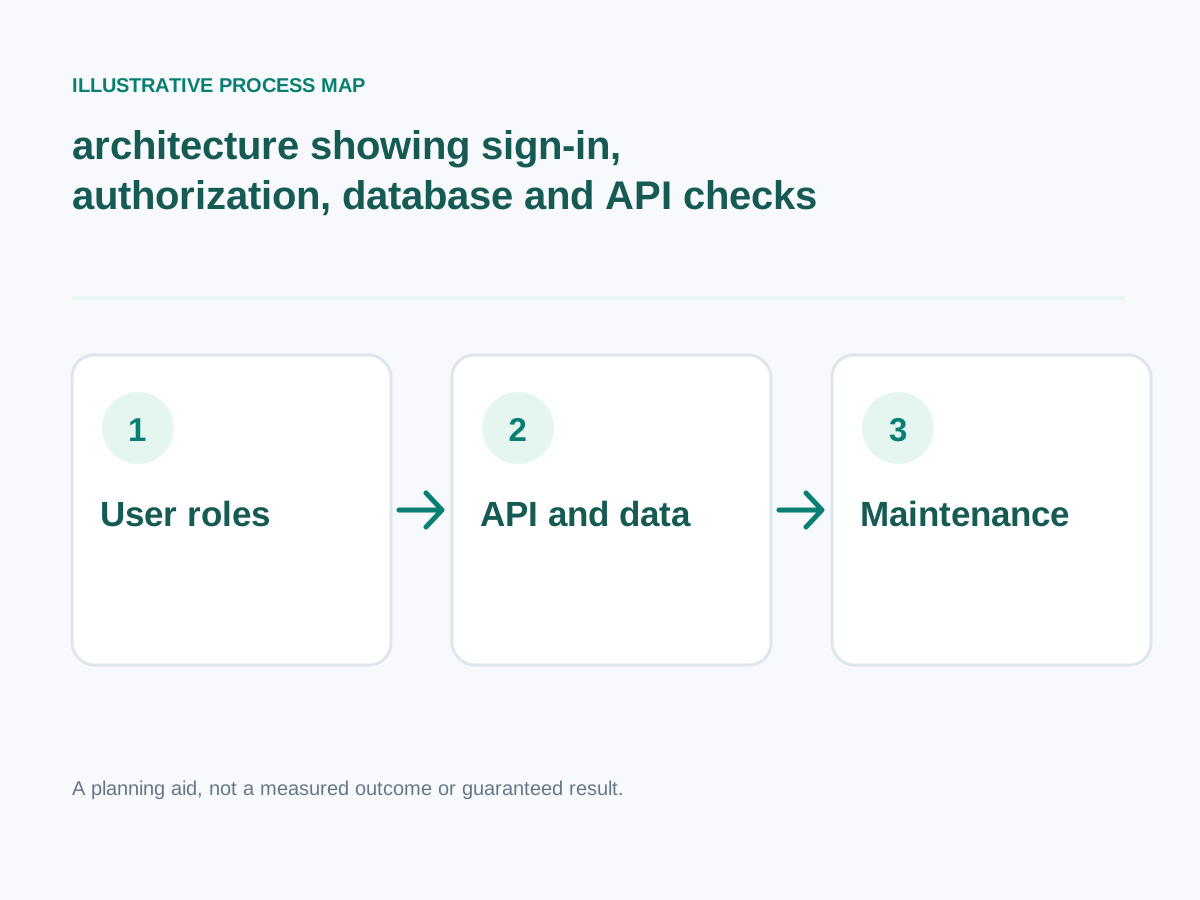
Conceptual workflow; adapt steps to your project.
Detailed step-by-step implementation plan
1. Define users, roles and permissions
Map who can view, create, edit, approve and export each record.
How to verify: Test sample operations under least-privilege accounts.
2. Separate MVP from later phases
Identify the one end-to-end workflow that proves the product is useful, and defer optional dashboards and customization.
How to verify: Prioritize scenarios by user value and dependency.
3. Model data and migrations
Map entities, ownership, relationships, deletion requirements, backups and future data import.
How to verify: Prototype the schema with realistic edge cases.
4. Specify integration contracts
Note authentication, request limits, data freshness, retry behavior and who pays for third-party APIs.
How to verify: Test API failures and malformed responses.
5. Estimate interface complexity
Count unique workflows, accessibility states, validation rules, interactive tables, upload flows and mobile needs.
How to verify: Walk through prototypes with intended users.
6. Include security and privacy work
Define session management, authorization, encryption, logging, retention and applicable data obligations.
How to verify: Perform permission and sensitive-data exposure tests.
7. Plan testing layers
Unit, integration, browser and load tests should match product risk, not just number of pages.
How to verify: Describe the acceptance tests for critical actions.
8. Define deployment and observability
Include staging, CI, database changes, alerting, backups, and incident ownership.
How to verify: Rehearse deployment and recovery procedures.
9. Estimate recurring cloud and vendor costs
Compute storage, database, email, payments, analytics, queues and third-party licenses under realistic usage assumptions.
How to verify: Model low, normal and peak usage scenarios.
10. Choose milestones based on proof
Fund a discovery prototype, working MVP, security review and launch in stages to learn before expanding scope.
How to verify: Require working demonstrations and tested acceptance criteria.
Worked decision scenario
Illustrative business situation: A service company automating internal job approvals may need just three user roles and a few screens; a marketplace with dispute handling, payments, messaging and onboarding has a much larger threat model and testing surface.
For this situation, begin with specify integration contracts: Note authentication, request limits, data freshness, retry behavior and who pays for third-party APIs. This clarifies an early implementation dependency before committing to a large rewrite.
The next decision concerns estimate interface complexity: Count unique workflows, accessibility states, validation rules, interactive tables, upload flows and mobile needs. In a practical project, translate this requirement into a demonstration that the owner, staff and end user can understand. The suggested acceptance check is: Walk through prototypes with intended users.
Finally, review include security and privacy work: Define session management, authorization, encryption, logging, retention and applicable data obligations. This example is hypothetical, not a claimed client engagement. No before-and-after revenue or search result is implied. A real case study would require prior measurements, documented implementation, permission and an accurate description of what happened.
Measurement plan: what to track and what not to assume
Map project cost to authenticated roles, data models, integrations, reliability and testing requirements. Measure whether a smaller first release solves the business workflow before funding advanced features.
Start with these practical evidence points: define deployment and observability — Rehearse deployment and recovery procedures. Next examine estimate recurring cloud and vendor costs — Model low, normal and peak usage scenarios. Then assess choose milestones based on proof — Require working demonstrations and tested acceptance criteria.
Common mistakes and safer alternatives
- Skipping separate mvp from later phases. Corrective approach: Identify the one end-to-end workflow that proves the product is useful, and defer optional dashboards and customization. To know whether the fix works, prioritize scenarios by user value and dependency.
- Skipping specify integration contracts. Corrective approach: Note authentication, request limits, data freshness, retry behavior and who pays for third-party APIs. To know whether the fix works, test API failures and malformed responses.
- Skipping include security and privacy work. Corrective approach: Define session management, authorization, encryption, logging, retention and applicable data obligations. To know whether the fix works, perform permission and sensitive-data exposure tests.
- Skipping define deployment and observability. Corrective approach: Include staging, CI, database changes, alerting, backups, and incident ownership. To know whether the fix works, rehearse deployment and recovery procedures.
- Skipping choose milestones based on proof. Corrective approach: Fund a discovery prototype, working MVP, security review and launch in stages to learn before expanding scope. To know whether the fix works, require working demonstrations and tested acceptance criteria.
A practical four-week execution roadmap
Week 1 — Diagnose and establish requirements: Focus on define users, roles and permissions, separate mvp from later phases, model data and migrations. Test sample operations under least-privilege accounts.; Prioritize scenarios by user value and dependency.
Week 2 — Prototype the highest-impact change: Focus on specify integration contracts, estimate interface complexity. Test API failures and malformed responses.; Walk through prototypes with intended users.
Week 3 — Implement and validate: Focus on include security and privacy work, plan testing layers, define deployment and observability. Perform permission and sensitive-data exposure tests.; Describe the acceptance tests for critical actions.
Week 4 — Verify decisions: Revisit these priorities: estimate recurring cloud and vendor costs, choose milestones based on proof. Model low, normal and peak usage scenarios. Require working demonstrations and tested acceptance criteria. Document the date, measurement method and any unresolved risks.
Final checklist before hiring or implementing
- Test sample operations under least-privilege accounts.
- Prioritize scenarios by user value and dependency.
- Prototype the schema with realistic edge cases.
- Test API failures and malformed responses.
- Walk through prototypes with intended users.
- Perform permission and sensitive-data exposure tests.
- Describe the acceptance tests for critical actions.
- Rehearse deployment and recovery procedures.
- Model low, normal and peak usage scenarios.
- Require working demonstrations and tested acceptance criteria.
Want help implementing this?
Need implementation support? If you want to plan a secure web application build, review my primary development service and related specialist service. You can also try the free website-planning tools before discussing scope. Book a free consultation to discuss your specific requirements; results depend on traffic, implementation and the business context.
Reference material and transparency
Documentation reviewed: 30 October 2026.
-
Verified technical fact: OWASP ASVS is a published framework of security requirements for designing, developing and testing web applications, not a guarantee that any particular app is secure. OWASP
-
Verified technical fact: W3C's accessible-forms guidance calls for clear labels, instructions and input validation. Client-side validation alone is not a security control. W3C WAI
-
Verified technical fact: WCAG 2.2 target size minimum at Level AA is generally 24 by 24 CSS pixels with stated exceptions; the 44 by 44 enhanced criterion is Level AAA, not a universal AA rule. W3C
Future pricing: No 2027 supplier, plan, tax or exchange-rate amount is asserted here. Refresh official prices and obtain comparable written quotations near publication. Additional checked source (30 October 2026): OWASP's Application Security Verification Standard is a published framework of web application security requirements and tests. Official primary source
Scope / limits: Passing a checklist or quoting ASVS does not certify this article's hypothetical app; actual security assessment and estimates require scoped engineering.
Evidence boundary: The official links below substantiate these specific platform/technical facts, not the article's illustrative scenarios, a guaranteed traffic/sales outcome, or any claim about an actual client.