The practical answer
Hotel direct booking website: here is a practical decision framework.
A hotel website competes for trust and convenience during a high-stakes transaction: guests must confirm dates, room category, amenities, total price and cancellation terms. Direct booking growth depends on reliable inventory, accurate policies and a smooth reservation journey—not merely a Book Now button.
For independent hotel operators, the first decisions are clarify room categories, display accurate total pricing, and connect booking availability. These are linked: solving the later step before checking the earlier one may waste time or create additional operating costs. A useful plan therefore defines how the customer journey should work and tests its critical assumptions before investing in more features.
Illustrative situation (not a client case study): A small independent hotel may get visitors from maps and search but lose them when the booking widget takes too long, hides taxes until the end or shows unavailable rooms as bookable.
Important limitation: Direct booking is not free acquisition. Compare booking engine fees, payment costs, marketing, guest support and channel-management responsibilities.
Original illustration—not a customer screenshot or measured result.
Before you change anything: a short diagnostic
A good investigation starts with clarify room categories. Show real room imagery, occupancy, bedding, amenities, accessibility and restrictions for each bookable category. Its first proof point should be: Compare website descriptions with front-desk inventory.
Next review display accurate total pricing. Explain taxes, service fees, breakfast, parking and extras before commitment, according to local legal requirements. An observable check is: Compare rate breakdown across desktop and mobile.
Third, examine connect booking availability. Synchronize room inventory and stop-sell rules with the property management or channel manager as appropriate. Evidence for this check is: Test a reservation and immediate inventory update.
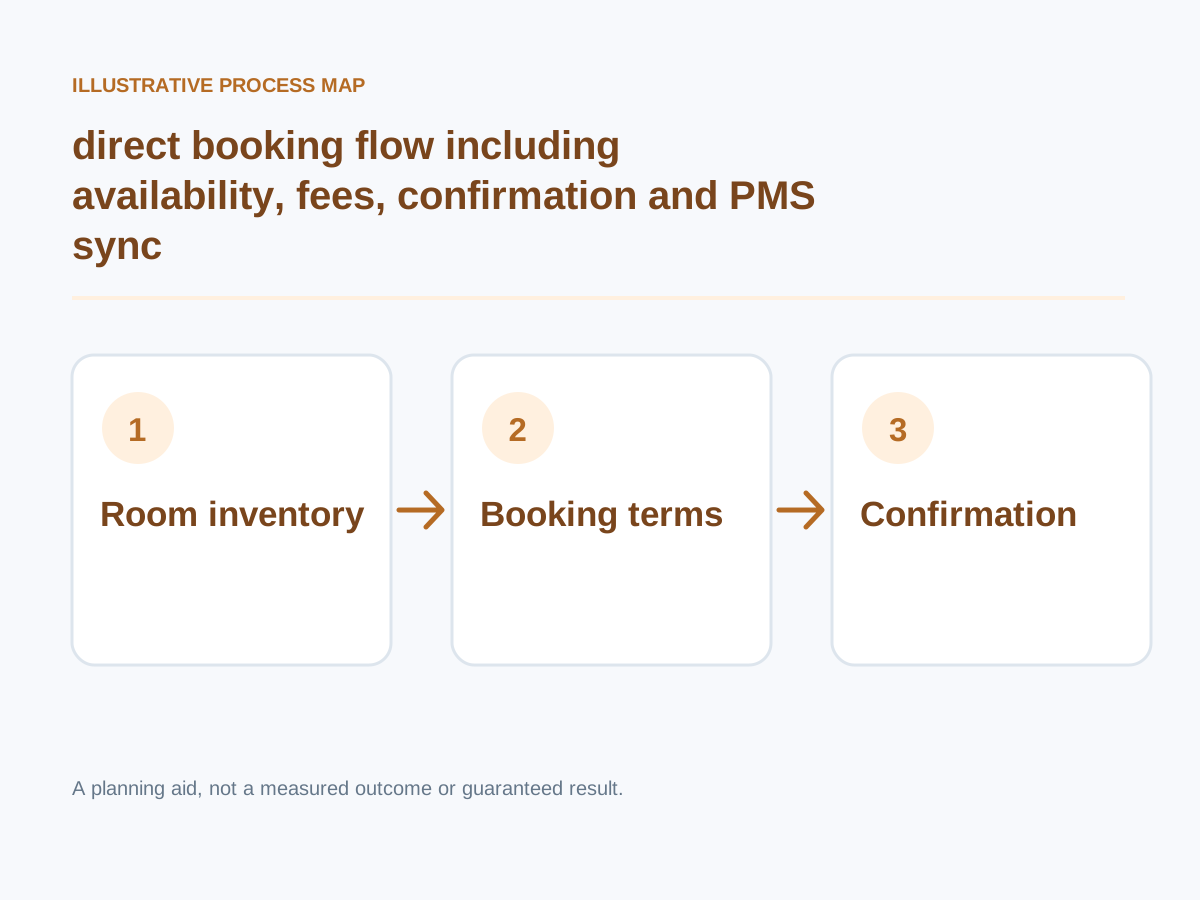
Conceptual workflow; adapt steps to your project.
Detailed step-by-step implementation plan
1. Clarify room categories
Show real room imagery, occupancy, bedding, amenities, accessibility and restrictions for each bookable category.
How to verify: Compare website descriptions with front-desk inventory.
2. Display accurate total pricing
Explain taxes, service fees, breakfast, parking and extras before commitment, according to local legal requirements.
How to verify: Compare rate breakdown across desktop and mobile.
3. Connect booking availability
Synchronize room inventory and stop-sell rules with the property management or channel manager as appropriate.
How to verify: Test a reservation and immediate inventory update.
4. Make cancellation terms easy to find
Differentiate refundable and non-refundable rates, modification windows and special event policies.
How to verify: Confirm staff and guests interpret the same rule.
5. Reduce mobile booking steps
Simplify dates, occupancy, room selection, contact details and payment without hiding important conditions.
How to verify: Complete a booking on a common phone.
6. Explain why book direct
Share legitimate benefits such as communication, flexibility or exclusive packages only when actually available.
How to verify: Verify that promised benefits can be delivered.
7. Improve local destination information
Add accurate proximity details, transport guidance, parking, check-in requirements and visitor FAQs.
How to verify: Validate travel information against current reliable sources.
8. Use genuine guest trust signals
Include verified reviews, accurate hotel photos, contact details and support channels; distinguish promotional renders from real rooms.
How to verify: Confirm approvals and claims.
9. Test payment and confirmation recovery
Handle authorization failures, duplicate bookings, cancellations and receipt emails.
How to verify: Reconcile test bookings with the property system.
10. Measure profitable channel mix
Compare direct room nights, booking value, cancellations, acquisition and support costs with intermediated bookings.
How to verify: Use reconciled reservation data rather than raw CTA clicks.
Worked decision scenario
Illustrative business situation: A small independent hotel may get visitors from maps and search but lose them when the booking widget takes too long, hides taxes until the end or shows unavailable rooms as bookable.
For this situation, begin with make cancellation terms easy to find: Differentiate refundable and non-refundable rates, modification windows and special event policies. This clarifies an early implementation dependency before committing to a large rewrite.
The next decision concerns reduce mobile booking steps: Simplify dates, occupancy, room selection, contact details and payment without hiding important conditions. In a practical project, translate this requirement into a demonstration that the owner, staff and end user can understand. The suggested acceptance check is: Complete a booking on a common phone.
Finally, review explain why book direct: Share legitimate benefits such as communication, flexibility or exclusive packages only when actually available. This example is hypothetical, not a claimed client engagement. No before-and-after revenue or search result is implied. A real case study would require prior measurements, documented implementation, permission and an accurate description of what happened.
Measurement plan: what to track and what not to assume
Reconcile completed direct bookings with the property-management system and cancellations. Track net revenue by channel after payment fees and support costs, not merely booking CTA clicks.
Start with these practical evidence points: use genuine guest trust signals — Confirm approvals and claims. Next examine test payment and confirmation recovery — Reconcile test bookings with the property system. Then assess measure profitable channel mix — Use reconciled reservation data rather than raw CTA clicks.
Common mistakes and safer alternatives
- Skipping display accurate total pricing. Corrective approach: Explain taxes, service fees, breakfast, parking and extras before commitment, according to local legal requirements. To know whether the fix works, compare rate breakdown across desktop and mobile.
- Skipping make cancellation terms easy to find. Corrective approach: Differentiate refundable and non-refundable rates, modification windows and special event policies. To know whether the fix works, confirm staff and guests interpret the same rule.
- Skipping explain why book direct. Corrective approach: Share legitimate benefits such as communication, flexibility or exclusive packages only when actually available. To know whether the fix works, verify that promised benefits can be delivered.
- Skipping use genuine guest trust signals. Corrective approach: Include verified reviews, accurate hotel photos, contact details and support channels; distinguish promotional renders from real rooms. To know whether the fix works, confirm approvals and claims.
- Skipping measure profitable channel mix. Corrective approach: Compare direct room nights, booking value, cancellations, acquisition and support costs with intermediated bookings. To know whether the fix works, use reconciled reservation data rather than raw CTA clicks.
A practical four-week execution roadmap
Week 1 — Diagnose and establish requirements: Focus on clarify room categories, display accurate total pricing, connect booking availability. Compare website descriptions with front-desk inventory.; Compare rate breakdown across desktop and mobile.
Week 2 — Prototype the highest-impact change: Focus on make cancellation terms easy to find, reduce mobile booking steps. Confirm staff and guests interpret the same rule.; Complete a booking on a common phone.
Week 3 — Implement and validate: Focus on explain why book direct, improve local destination information, use genuine guest trust signals. Verify that promised benefits can be delivered.; Validate travel information against current reliable sources.
Week 4 — Verify decisions: Revisit these priorities: test payment and confirmation recovery, measure profitable channel mix. Reconcile test bookings with the property system. Use reconciled reservation data rather than raw CTA clicks. Document the date, measurement method and any unresolved risks.
Final checklist before hiring or implementing
- Compare website descriptions with front-desk inventory.
- Compare rate breakdown across desktop and mobile.
- Test a reservation and immediate inventory update.
- Confirm staff and guests interpret the same rule.
- Complete a booking on a common phone.
- Verify that promised benefits can be delivered.
- Validate travel information against current reliable sources.
- Confirm approvals and claims.
- Reconcile test bookings with the property system.
- Use reconciled reservation data rather than raw CTA clicks.
Want help implementing this?
Need implementation support? If you want to reduce friction in direct hotel booking, review my primary development service and related specialist service. You can also try the free website-planning tools before discussing scope. Book a free consultation to discuss your specific requirements; results depend on traffic, implementation and the business context.
Reference material and transparency
Documentation reviewed: 30 October 2026.
-
Verified technical fact: W3C's accessible-forms guidance calls for clear labels, instructions and input validation. Client-side validation alone is not a security control. W3C WAI
-
Verified technical fact: Google uses mobile page content for mobile-first indexing and recommends responsive design because it is generally easiest to implement and maintain. Google Search Central
-
Verified technical fact: Google states that applying SEO guidance does not guarantee that a page is indexed or ranks first. Google Search Central
Local compliance: Verify property, appointment, restaurant, hospitality and privacy requirements with the actual business and applicable local rules. Additional checked source (30 October 2026): Accessible, clearly labeled reservation forms aid discoverability of guest actions under W3C guidance. Official primary source
Scope / limits: Hotel room rates, inventory/PMS synchronization, taxes and cancellation policies can only be verified for the actual hotel and target market.
Evidence boundary: The official links below substantiate these specific platform/technical facts, not the article's illustrative scenarios, a guaranteed traffic/sales outcome, or any claim about an actual client.