The practical answer
Jewellery ecommerce conversion rate: here is a practical decision framework.
Jewellery purchases are sensitive to presentation, authenticity, size, gifting confidence and return conditions. A store can attract the right visitors but lose trust when materials, dimensions and after-sales policies are unclear. Better conversion starts with accurate product storytelling and low-friction purchase flows.
For jewellery ecommerce brands, the first decisions are explain material and authenticity, build strong visual inspection, and make size selection understandable. These are linked: solving the later step before checking the earlier one may waste time or create additional operating costs. A useful plan therefore defines how the customer journey should work and tests its critical assumptions before investing in more features.
Illustrative situation (not a client case study): A customer choosing a gemstone ring needs to understand size, metal composition, stone details, certification where relevant, estimated delivery and return eligibility. A single glamour photo cannot answer those questions.
Important limitation: Do not imply a gem is certified, solid gold or an investment unless supporting documentation confirms the claim. Precious-metal marking and consumer rules vary by market.
Original illustration—not a customer screenshot or measured result.
Before you change anything: a short diagnostic
A good investigation starts with explain material and authenticity. Show actual metal, plating, gemstone, weight and certification information where applicable. Its first proof point should be: Verify claims against product and supplier records.
Next review build strong visual inspection. Offer scale references, multiple angles, close-ups and truthful imagery showing clasps and surface details. An observable check is: Ask shoppers whether they can judge proportion and finish.
Third, examine make size selection understandable. Provide ring measurement guidance, chain lengths and adjustable-fit information; explain limitations of at-home measurement. Evidence for this check is: Test whether customers can select a size confidently.
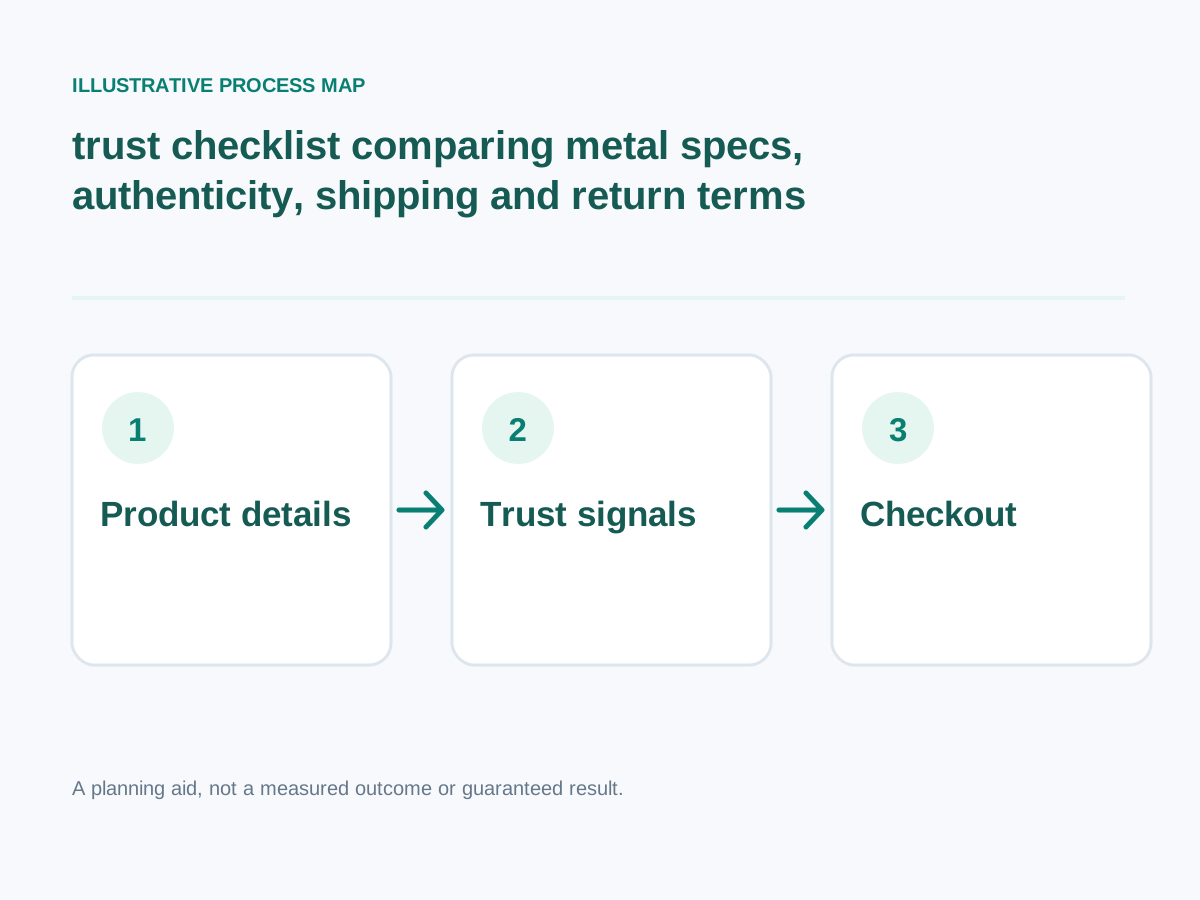
Conceptual workflow; adapt steps to your project.
Detailed step-by-step implementation plan
1. Explain material and authenticity
Show actual metal, plating, gemstone, weight and certification information where applicable.
How to verify: Verify claims against product and supplier records.
2. Build strong visual inspection
Offer scale references, multiple angles, close-ups and truthful imagery showing clasps and surface details.
How to verify: Ask shoppers whether they can judge proportion and finish.
3. Make size selection understandable
Provide ring measurement guidance, chain lengths and adjustable-fit information; explain limitations of at-home measurement.
How to verify: Test whether customers can select a size confidently.
4. Clarify value and pricing
Display price, applicable charges, delivery and customization costs transparently rather than springing fees at checkout.
How to verify: Compare product page and final basket totals.
5. Explain returns and resizing
State hygiene, customized-item and gemstone exclusions if lawful, along with repair and resizing processes.
How to verify: Review actual support cases against policy wording.
6. Build occasion-based navigation
Use helpful categories for weddings, gifting, everyday wear and material preferences without creating thin copies.
How to verify: Observe customer product discovery paths.
7. Improve mobile product views
Keep images sharp, variants accessible, stock visible and the add-to-cart action unobstructed.
How to verify: Complete selection and purchase on a phone.
8. Add authentic proof
Use permissioned customer photos, documented brand details and verifiable certifications or craftsmanship demonstrations.
How to verify: Audit ownership and truthfulness of every asset.
9. Test high-value checkout protection
Verify payment flows, secure handling, address confirmation, insured shipment and customer service.
How to verify: Run test orders and failure recovery.
10. Use post-purchase education
Provide care instructions, packaging expectations and support so customers know what they bought.
How to verify: Track product questions, returns and repeat purchases.
Worked decision scenario
Illustrative business situation: A customer choosing a gemstone ring needs to understand size, metal composition, stone details, certification where relevant, estimated delivery and return eligibility. A single glamour photo cannot answer those questions.
For this situation, begin with clarify value and pricing: Display price, applicable charges, delivery and customization costs transparently rather than springing fees at checkout. This clarifies an early implementation dependency before committing to a large rewrite.
The next decision concerns explain returns and resizing: State hygiene, customized-item and gemstone exclusions if lawful, along with repair and resizing processes. In a practical project, translate this requirement into a demonstration that the owner, staff and end user can understand. The suggested acceptance check is: Review actual support cases against policy wording.
Finally, review build occasion-based navigation: Use helpful categories for weddings, gifting, everyday wear and material preferences without creating thin copies. This example is hypothetical, not a claimed client engagement. No before-and-after revenue or search result is implied. A real case study would require prior measurements, documented implementation, permission and an accurate description of what happened.
Measurement plan: what to track and what not to assume
Observe product-detail engagement, size/metal information views, completed checkouts and returns. Investigate uncertainty about authenticity and shipping promises without inventing conversion uplifts.
Start with these practical evidence points: add authentic proof — Audit ownership and truthfulness of every asset. Next examine test high-value checkout protection — Run test orders and failure recovery. Then assess use post-purchase education — Track product questions, returns and repeat purchases.
Common mistakes and safer alternatives
- Skipping build strong visual inspection. Corrective approach: Offer scale references, multiple angles, close-ups and truthful imagery showing clasps and surface details. To know whether the fix works, ask shoppers whether they can judge proportion and finish.
- Skipping clarify value and pricing. Corrective approach: Display price, applicable charges, delivery and customization costs transparently rather than springing fees at checkout. To know whether the fix works, compare product page and final basket totals.
- Skipping build occasion-based navigation. Corrective approach: Use helpful categories for weddings, gifting, everyday wear and material preferences without creating thin copies. To know whether the fix works, observe customer product discovery paths.
- Skipping add authentic proof. Corrective approach: Use permissioned customer photos, documented brand details and verifiable certifications or craftsmanship demonstrations. To know whether the fix works, audit ownership and truthfulness of every asset.
- Skipping use post-purchase education. Corrective approach: Provide care instructions, packaging expectations and support so customers know what they bought. To know whether the fix works, track product questions, returns and repeat purchases.
A practical four-week execution roadmap
Week 1 — Diagnose and establish requirements: Focus on explain material and authenticity, build strong visual inspection, make size selection understandable. Verify claims against product and supplier records.; Ask shoppers whether they can judge proportion and finish.
Week 2 — Prototype the highest-impact change: Focus on clarify value and pricing, explain returns and resizing. Compare product page and final basket totals.; Review actual support cases against policy wording.
Week 3 — Implement and validate: Focus on build occasion-based navigation, improve mobile product views, add authentic proof. Observe customer product discovery paths.; Complete selection and purchase on a phone.
Week 4 — Verify decisions: Revisit these priorities: test high-value checkout protection, use post-purchase education. Run test orders and failure recovery. Track product questions, returns and repeat purchases. Document the date, measurement method and any unresolved risks.
Final checklist before hiring or implementing
- Verify claims against product and supplier records.
- Ask shoppers whether they can judge proportion and finish.
- Test whether customers can select a size confidently.
- Compare product page and final basket totals.
- Review actual support cases against policy wording.
- Observe customer product discovery paths.
- Complete selection and purchase on a phone.
- Audit ownership and truthfulness of every asset.
- Run test orders and failure recovery.
- Track product questions, returns and repeat purchases.
Want help implementing this?
Need implementation support? If you want to improve a jewellery storefront, review my primary development service and related specialist service. You can also try the free website-planning tools before discussing scope. Book a free consultation to discuss your specific requirements; results depend on traffic, implementation and the business context.
Reference material and transparency
Documentation reviewed: 30 October 2026.
-
Verified technical fact: Google's ecommerce guidance explains how crawlable internal linking, navigation and structured product information help search systems discover and interpret online store pages. Google Search Central
-
Verified technical fact: Google recommends relevant images near meaningful page text and descriptive alt text; keyword-stuffed image alt is discouraged. Google Search Central
-
Verified technical fact: Valid structured data can make a page eligible for certain rich results, but Google explicitly does not guarantee a rich-result display. Google Search Central
Additional checked source (30 October 2026): The Bureau of Indian Standards BIS Care App supports verifying the HUID of eligible hallmarked jewellery in India. Official primary source
Scope / limits: Never infer authenticity of a specific item from a generic badge; check HUID and documentation for the exact product and applicable location.
Evidence boundary: The official links below substantiate these specific platform/technical facts, not the article's illustrative scenarios, a guaranteed traffic/sales outcome, or any claim about an actual client.