The practical answer
Starting an online store is a sequence of business decisions, not just choosing a website theme. You need customer demand, a workable product and fulfillment model, transparent policies, compliant payments and a reliable store experience. Build the smallest version that can handle a genuine end-to-end order safely.
For first-time ecommerce entrepreneurs, the first decisions are validate a specific customer problem, calculate unit economics, and choose how you will fulfill orders. These are linked: solving the later step before checking the earlier one may waste time or create additional operating costs. A useful plan therefore defines how the customer journey should work and tests its critical assumptions before investing in more features.
Illustrative situation (not a client case study): Imagine a small stationery maker launching ten products. The initial objective is not a complex loyalty program; it is accurate product pages, realistic shipping promises, payment confirmation and a customer support process.
Important limitation: Business registration, tax obligations, consumer protection and product rules vary by jurisdiction. Consult local professionals and official regulations before accepting payments.
Original illustration—not a customer screenshot or measured result.
Before you change anything: a short diagnostic
A good investigation starts with validate a specific customer problem. Describe who buys the product, what alternatives exist, why your offer is different and what objections customers have. Its first proof point should be: Interview prospective buyers rather than using only social likes.
Next review calculate unit economics. Track product cost, packaging, shipping, payment fees, returns, advertising and contribution margin. An observable check is: Create a sample order margin worksheet for several basket sizes.
Third, examine choose how you will fulfill orders. Decide between own inventory, made-to-order, dropshipping or third-party fulfillment; define stock and delivery responsibility. Evidence for this check is: Walk through dispatch and a failed delivery before launch.
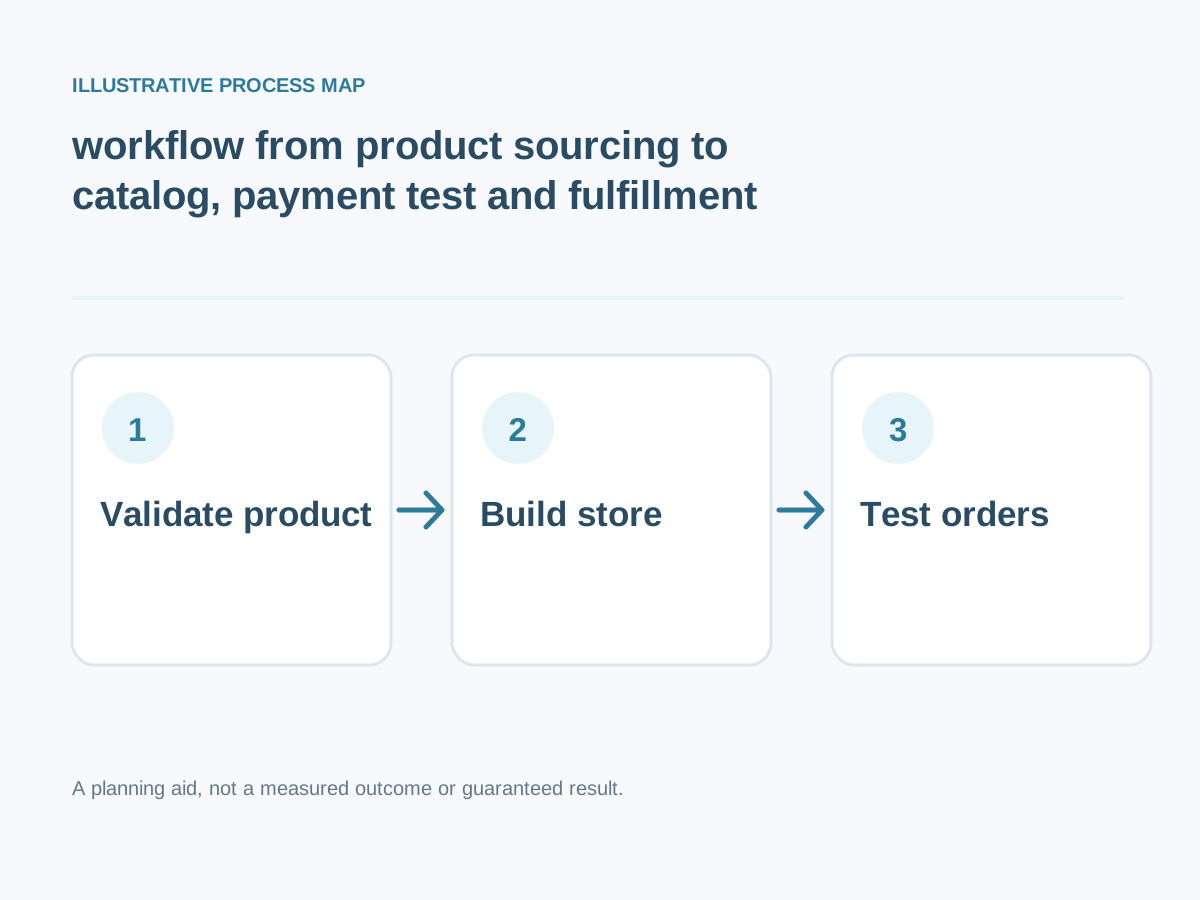
Conceptual workflow; adapt steps to your project.
Detailed step-by-step implementation plan
1. Validate a specific customer problem
Describe who buys the product, what alternatives exist, why your offer is different and what objections customers have.
How to verify: Interview prospective buyers rather than using only social likes.
2. Calculate unit economics
Track product cost, packaging, shipping, payment fees, returns, advertising and contribution margin.
How to verify: Create a sample order margin worksheet for several basket sizes.
3. Choose how you will fulfill orders
Decide between own inventory, made-to-order, dropshipping or third-party fulfillment; define stock and delivery responsibility.
How to verify: Walk through dispatch and a failed delivery before launch.
4. Select a platform and domain
Choose a platform based on payment support, catalog needs, content tools and maintenance capacity; buy a memorable domain with access retained by the owner.
How to verify: Verify account ownership, domain control and backups.
5. Build a useful product catalog
Write accurate titles, variant options, specifications, sizing, photos and stock conditions; avoid manufacturer-copy duplication where possible.
How to verify: Have someone unfamiliar with the products choose the correct variant.
6. Set up policies clearly
Draft shipping, refunds, privacy and customer-service details aligned with actual operations and local law.
How to verify: Check that policy links are visible before payment.
7. Configure payments and taxes
Use a supported payment provider, identity/business verification and appropriate tax configuration.
How to verify: Run sandbox transactions for success, failure, cancellation and refund.
8. Test mobile buying end to end
Confirm search, navigation, filters, cart, address entry, payments and order confirmation on phones.
How to verify: Complete test orders without developer assistance.
9. Add consent-aware measurement
Record product views, cart actions, checkout stages and completed orders without treating analytics as perfectly complete.
How to verify: Match test events with actual orders and consent configuration.
10. Launch a learning loop
Start with a manageable audience, track support questions and return reasons, then prioritize fixes based on actual evidence.
How to verify: Review the first real orders for fulfillment problems and customer confusion.
Worked decision scenario
Illustrative business situation: Imagine a small stationery maker launching ten products. The initial objective is not a complex loyalty program; it is accurate product pages, realistic shipping promises, payment confirmation and a customer support process.
For this situation, begin with select a platform and domain: Choose a platform based on payment support, catalog needs, content tools and maintenance capacity; buy a memorable domain with access retained by the owner. This clarifies an early implementation dependency before committing to a large rewrite.
The next decision concerns build a useful product catalog: Write accurate titles, variant options, specifications, sizing, photos and stock conditions; avoid manufacturer-copy duplication where possible. In a practical project, translate this requirement into a demonstration that the owner, staff and end user can understand. The suggested acceptance check is: Have someone unfamiliar with the products choose the correct variant.
Finally, review set up policies clearly: Draft shipping, refunds, privacy and customer-service details aligned with actual operations and local law. This example is hypothetical, not a claimed client engagement. No before-and-after revenue or search result is implied. A real case study would require prior measurements, documented implementation, permission and an accurate description of what happened.
Measurement plan: what to track and what not to assume
Validate the chosen store with test transactions, refunds, shipping settings and a real product catalog. Track actual margin after fulfillment and fees, not simply store visits or initial orders.
Start with these practical evidence points: test mobile buying end to end — Complete test orders without developer assistance. Next examine add consent-aware measurement — Match test events with actual orders and consent configuration. Then assess launch a learning loop — Review the first real orders for fulfillment problems and customer confusion.
Common mistakes and safer alternatives
- Skipping calculate unit economics. Corrective approach: Track product cost, packaging, shipping, payment fees, returns, advertising and contribution margin. To know whether the fix works, create a sample order margin worksheet for several basket sizes.
- Skipping select a platform and domain. Corrective approach: Choose a platform based on payment support, catalog needs, content tools and maintenance capacity; buy a memorable domain with access retained by the owner. To know whether the fix works, verify account ownership, domain control and backups.
- Skipping set up policies clearly. Corrective approach: Draft shipping, refunds, privacy and customer-service details aligned with actual operations and local law. To know whether the fix works, check that policy links are visible before payment.
- Skipping test mobile buying end to end. Corrective approach: Confirm search, navigation, filters, cart, address entry, payments and order confirmation on phones. To know whether the fix works, complete test orders without developer assistance.
- Skipping launch a learning loop. Corrective approach: Start with a manageable audience, track support questions and return reasons, then prioritize fixes based on actual evidence. To know whether the fix works, review the first real orders for fulfillment problems and customer confusion.
A practical four-week execution roadmap
Week 1 — Diagnose and establish requirements: Focus on validate a specific customer problem, calculate unit economics, choose how you will fulfill orders. Interview prospective buyers rather than using only social likes.; Create a sample order margin worksheet for several basket sizes.
Week 2 — Prototype the highest-impact change: Focus on select a platform and domain, build a useful product catalog. Verify account ownership, domain control and backups.; Have someone unfamiliar with the products choose the correct variant.
Week 3 — Implement and validate: Focus on set up policies clearly, configure payments and taxes, test mobile buying end to end. Check that policy links are visible before payment.; Run sandbox transactions for success, failure, cancellation and refund.
Week 4 — Verify decisions: Revisit these priorities: add consent-aware measurement, launch a learning loop. Match test events with actual orders and consent configuration. Review the first real orders for fulfillment problems and customer confusion. Document the date, measurement method and any unresolved risks.
Final checklist before hiring or implementing
- Interview prospective buyers rather than using only social likes.
- Create a sample order margin worksheet for several basket sizes.
- Walk through dispatch and a failed delivery before launch.
- Verify account ownership, domain control and backups.
- Have someone unfamiliar with the products choose the correct variant.
- Check that policy links are visible before payment.
- Run sandbox transactions for success, failure, cancellation and refund.
- Complete test orders without developer assistance.
- Match test events with actual orders and consent configuration.
- Review the first real orders for fulfillment problems and customer confusion.
Want help implementing this?
Need implementation support? If you want to launch an online store with a testable checkout, review my primary development service and related specialist service. You can also try the free website-planning tools before discussing scope. Book a free consultation to discuss your specific requirements; results depend on traffic, implementation and the business context.
Reference material and transparency
Documentation reviewed: 30 October 2026.
-
Verified technical fact: Google's ecommerce guidance explains how crawlable internal linking, navigation and structured product information help search systems discover and interpret online store pages. Google Search Central
-
Verified technical fact: Shopify's checkout shipping options depend on store shipping configuration and the buyer's shipping address; merchants can verify them with test orders. Shopify Help Center
-
Verified technical fact: W3C's accessible-forms guidance calls for clear labels, instructions and input validation. Client-side validation alone is not a security control. W3C WAI
Additional checked source (30 October 2026): Shopify shipping zones and rates control what is charged at checkout, and merchant shipping configuration can vary by market. Official primary source
Scope / limits: Selling taxes, refunds, product safety and payment availability depend on jurisdiction and require the seller's policies.
Evidence boundary: The official links below substantiate these specific platform/technical facts, not the article's illustrative scenarios, a guaranteed traffic/sales outcome, or any claim about an actual client.