The practical answer
Shopify and WooCommerce solve similar commercial problems through different operating models. Shopify offers a hosted commerce ecosystem; WooCommerce extends WordPress with a self-managed store architecture. In 2027, compare verified current pricing and feature availability instead of assuming one platform is universally cheaper or better.
For founders choosing ecommerce software, the first decisions are compare business model compatibility, calculate total cost of ownership, and review theme and content workflows. These are linked: solving the later step before checking the earlier one may waste time or create additional operating costs. A useful plan therefore defines how the customer journey should work and tests its critical assumptions before investing in more features.
Illustrative situation (not a client case study): A new clothing startup may prioritize a predictable hosted checkout and low maintenance; a content-heavy publisher selling a small merchandise catalog may prefer its existing WordPress editorial workflows.
Important limitation: Verify pricing, transaction policies, checkout customization and app/plugin availability against official vendor sources at the time of decision; this comparison is a planning framework, not a timeless feature guarantee.
Original illustration—not a customer screenshot or measured result.
Before you change anything: a short diagnostic
A good investigation starts with compare business model compatibility. List physical products, downloads, subscriptions, wholesale accounts, multiple currencies and custom pricing needs. Its first proof point should be: Check each requirement against current platform documentation.
Next review calculate total cost of ownership. Include subscriptions, hosting, payment fees, apps/plugins, support, custom development and migration across more than one year. An observable check is: Create a transparent comparison using actual current quotes.
Third, examine review theme and content workflows. Test how staff create campaigns, landing pages, product variants, blog posts and seasonal collections. Evidence for this check is: Observe a nontechnical employee completing typical edits.
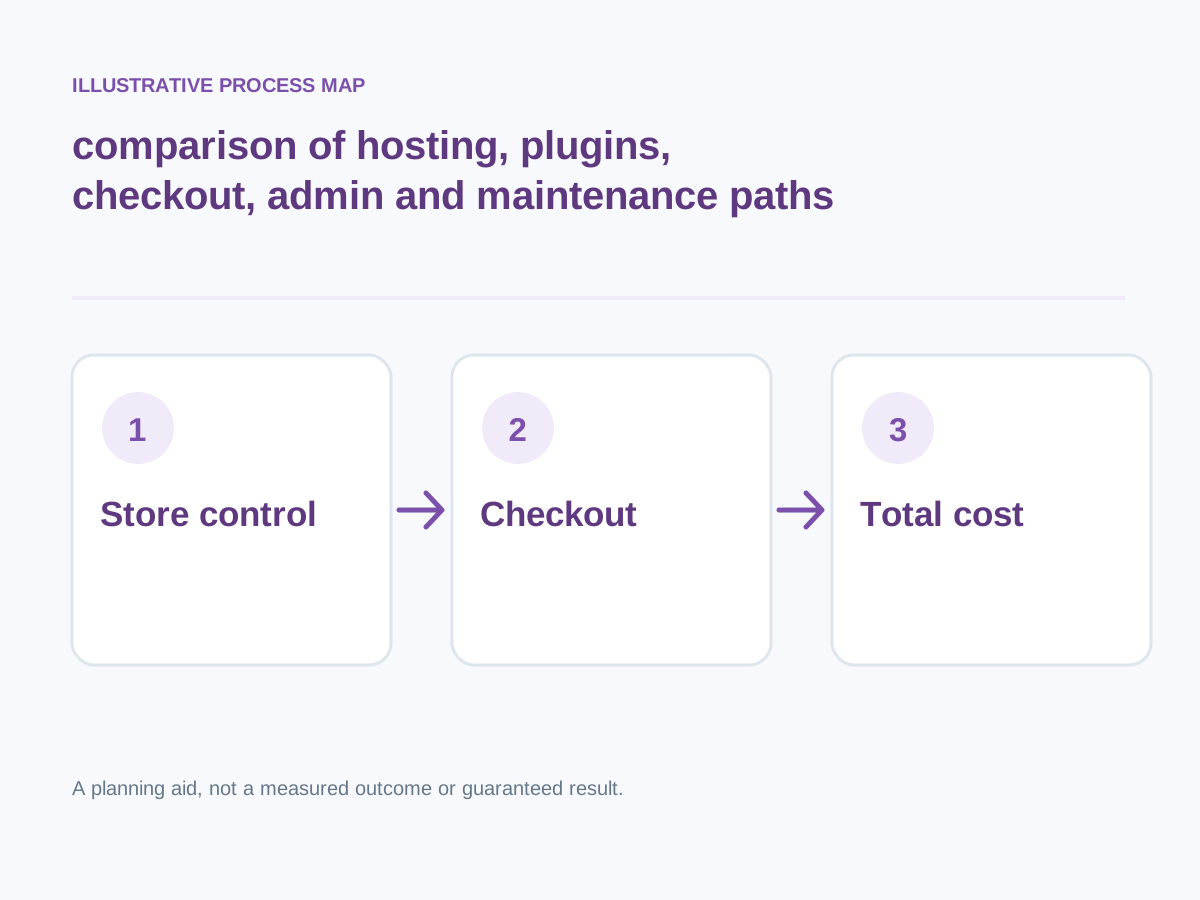
Conceptual workflow; adapt steps to your project.
Detailed step-by-step implementation plan
1. Compare business model compatibility
List physical products, downloads, subscriptions, wholesale accounts, multiple currencies and custom pricing needs.
How to verify: Check each requirement against current platform documentation.
2. Calculate total cost of ownership
Include subscriptions, hosting, payment fees, apps/plugins, support, custom development and migration across more than one year.
How to verify: Create a transparent comparison using actual current quotes.
3. Review theme and content workflows
Test how staff create campaigns, landing pages, product variants, blog posts and seasonal collections.
How to verify: Observe a nontechnical employee completing typical edits.
4. Investigate checkout requirements
Determine which payment options, tax logic, promotions and account experiences are truly supported.
How to verify: Test a real-like order journey in the target market.
5. Assess SEO architecture
Review product URLs, collections/categories, canonicals, structured data, internal links and redirects.
How to verify: Crawl sample templates and compare what search engines can render.
6. Plan speed and extension discipline
Hosted infrastructure reduces some maintenance but apps can add overhead; self-hosting permits flexibility but requires operations.
How to verify: Benchmark representative product and collection pages.
7. Examine data portability
Understand product, order, customer, content and media exports plus migration complications.
How to verify: Export representative data in a test environment.
8. Consider security responsibilities
Shopify handles much platform infrastructure, while WooCommerce operators manage hosting, plugins and updates.
How to verify: Write down responsibility for every security layer.
9. Model international sales
Verify markets, localization, shipping, payments, tax handling and customer support needs.
How to verify: Complete example orders for target countries.
10. Choose a measurable pilot
Use a small representative catalog and actual fulfillment rules to confirm the choice before large customization.
How to verify: Score time-to-launch, buyer usability and operating burden.
Worked decision scenario
Illustrative business situation: A new clothing startup may prioritize a predictable hosted checkout and low maintenance; a content-heavy publisher selling a small merchandise catalog may prefer its existing WordPress editorial workflows.
For this situation, begin with investigate checkout requirements: Determine which payment options, tax logic, promotions and account experiences are truly supported. This clarifies an early implementation dependency before committing to a large rewrite.
The next decision concerns assess seo architecture: Review product URLs, collections/categories, canonicals, structured data, internal links and redirects. In a practical project, translate this requirement into a demonstration that the owner, staff and end user can understand. The suggested acceptance check is: Crawl sample templates and compare what search engines can render.
Finally, review plan speed and extension discipline: Hosted infrastructure reduces some maintenance but apps can add overhead; self-hosting permits flexibility but requires operations. This example is hypothetical, not a claimed client engagement. No before-and-after revenue or search result is implied. A real case study would require prior measurements, documented implementation, permission and an accurate description of what happened.
Measurement plan: what to track and what not to assume
Compare test checkout scenarios, operating fees, inventory workflows and content control in both Shopify and WooCommerce. Make the decision using a documented merchant requirement list, not popularity rankings.
Start with these practical evidence points: consider security responsibilities — Write down responsibility for every security layer. Next examine model international sales — Complete example orders for target countries. Then assess choose a measurable pilot — Score time-to-launch, buyer usability and operating burden.
Common mistakes and safer alternatives
- Skipping calculate total cost of ownership. Corrective approach: Include subscriptions, hosting, payment fees, apps/plugins, support, custom development and migration across more than one year. To know whether the fix works, create a transparent comparison using actual current quotes.
- Skipping investigate checkout requirements. Corrective approach: Determine which payment options, tax logic, promotions and account experiences are truly supported. To know whether the fix works, test a real-like order journey in the target market.
- Skipping plan speed and extension discipline. Corrective approach: Hosted infrastructure reduces some maintenance but apps can add overhead; self-hosting permits flexibility but requires operations. To know whether the fix works, benchmark representative product and collection pages.
- Skipping consider security responsibilities. Corrective approach: Shopify handles much platform infrastructure, while WooCommerce operators manage hosting, plugins and updates. To know whether the fix works, write down responsibility for every security layer.
- Skipping choose a measurable pilot. Corrective approach: Use a small representative catalog and actual fulfillment rules to confirm the choice before large customization. To know whether the fix works, score time-to-launch, buyer usability and operating burden.
A practical four-week execution roadmap
Week 1 — Diagnose and establish requirements: Focus on compare business model compatibility, calculate total cost of ownership, review theme and content workflows. Check each requirement against current platform documentation.; Create a transparent comparison using actual current quotes.
Week 2 — Prototype the highest-impact change: Focus on investigate checkout requirements, assess seo architecture. Test a real-like order journey in the target market.; Crawl sample templates and compare what search engines can render.
Week 3 — Implement and validate: Focus on plan speed and extension discipline, examine data portability, consider security responsibilities. Benchmark representative product and collection pages.; Export representative data in a test environment.
Week 4 — Verify decisions: Revisit these priorities: model international sales, choose a measurable pilot. Complete example orders for target countries. Score time-to-launch, buyer usability and operating burden. Document the date, measurement method and any unresolved risks.
Final checklist before hiring or implementing
- Check each requirement against current platform documentation.
- Create a transparent comparison using actual current quotes.
- Observe a nontechnical employee completing typical edits.
- Test a real-like order journey in the target market.
- Crawl sample templates and compare what search engines can render.
- Benchmark representative product and collection pages.
- Export representative data in a test environment.
- Write down responsibility for every security layer.
- Complete example orders for target countries.
- Score time-to-launch, buyer usability and operating burden.
Want help implementing this?
Need implementation support? If you want to compare Shopify and WooCommerce architecture, review my primary development service and related specialist service. You can also try the free website-planning tools before discussing scope. Book a free consultation to discuss your specific requirements; results depend on traffic, implementation and the business context.
Reference material and transparency
Documentation reviewed: 30 October 2026.
-
Verified technical fact: WooCommerce is an open-source ecommerce plugin for WordPress and its core is free; related hosting, extensions and service costs are separate purchasing decisions. WordPress.org
-
Verified technical fact: Shopify merchant bills may include recurring plan or app charges, usage charges and one-time expenses; plan prices vary and must be checked when quoting. Shopify Help Center
-
Verified technical fact: Shopify store themes use templates, sections and blocks. Available customization controls depend on the theme and its version. Shopify Help Center
Future pricing: No 2027 supplier, plan, tax or exchange-rate amount is asserted here. Refresh official prices and obtain comparable written quotations near publication. Additional checked source (30 October 2026): WooCommerce is an open-source WordPress plugin; a free core does not mean hosting, third-party services, maintenance or extensions are free. Official primary source
Scope / limits: Shopify and WooCommerce plan charges and features in 2027 cannot be asserted as current facts in 2026; obtain updated vendor terms.
Evidence boundary: The official links below substantiate these specific platform/technical facts, not the article's illustrative scenarios, a guaranteed traffic/sales outcome, or any claim about an actual client.