The practical answer
Redesign pricing is not the price of repainting a homepage. It may include research, design systems, content rewriting, platform migration, new integrations, accessibility work, analytics and SEO preservation. A disciplined scope prevents hidden surprises and protects what already works.
For site owners evaluating redesign, the first decisions are audit what currently works, define redesign depth, and estimate content migration work. These are linked: solving the later step before checking the earlier one may waste time or create additional operating costs. A useful plan therefore defines how the customer journey should work and tests its critical assumptions before investing in more features.
Illustrative situation (not a client case study): A local consultancy refreshing navigation and typography has a very different redesign from a mature ecommerce brand switching platforms while preserving thousands of product URLs. Quote comparisons need to separate these scenarios.
Important limitation: Published costs vary by vendor, country and project scope. No precise price range should be treated as a live quote without recent verifiable market research.
Original illustration—not a customer screenshot or measured result.
Before you change anything: a short diagnostic
A good investigation starts with audit what currently works. Record converting pages, indexed URLs, navigation flows, integrations and most visited templates before replacing anything. Its first proof point should be: Preserve a baseline of organic traffic and lead submissions.
Next review define redesign depth. Distinguish visual refresh, UX restructuring, CMS migration, replatforming and full custom rebuild. An observable check is: Give each vendor the same list of changes.
Third, examine estimate content migration work. Count page templates, articles, metadata, downloads, images, translations and broken legacy assets. Evidence for this check is: Sample a migration and track content parity.
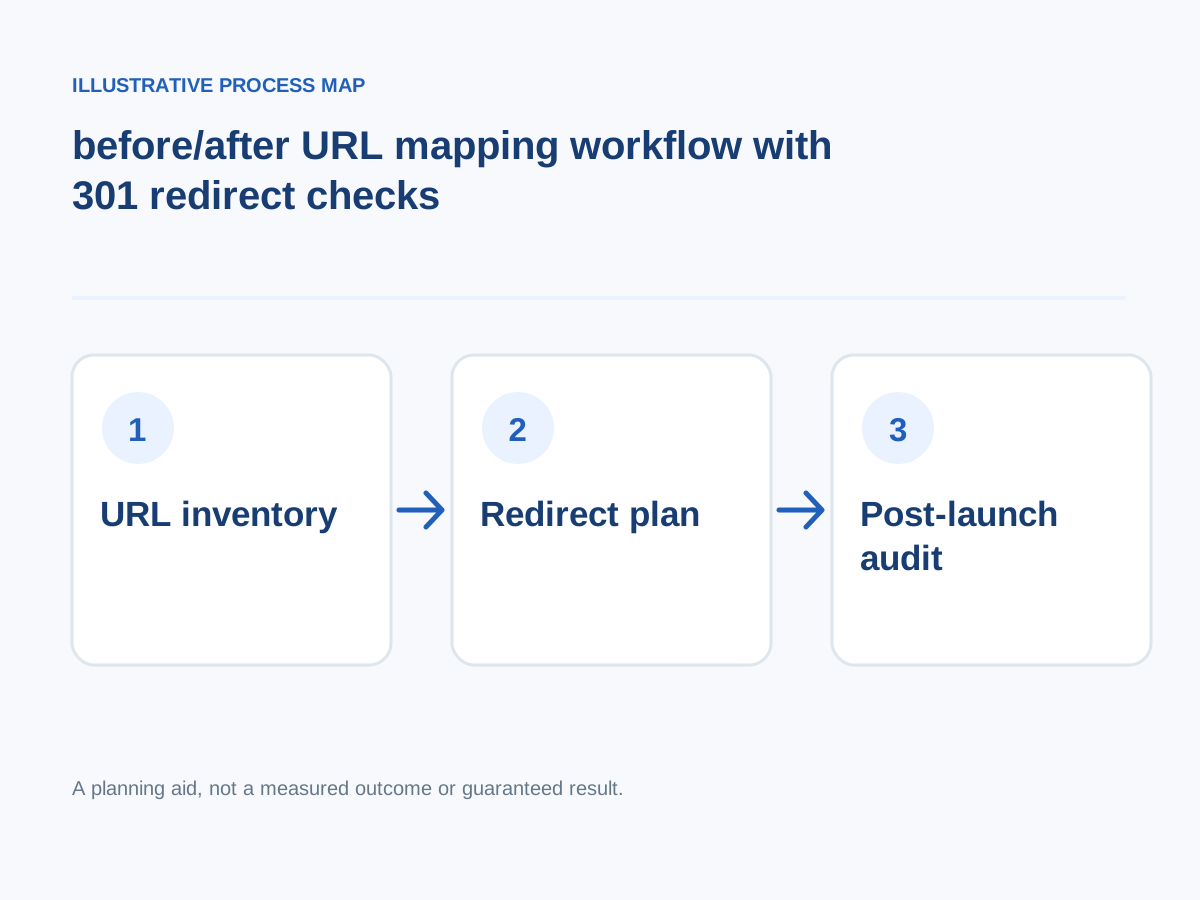
Conceptual workflow; adapt steps to your project.
Detailed step-by-step implementation plan
1. Audit what currently works
Record converting pages, indexed URLs, navigation flows, integrations and most visited templates before replacing anything.
How to verify: Preserve a baseline of organic traffic and lead submissions.
2. Define redesign depth
Distinguish visual refresh, UX restructuring, CMS migration, replatforming and full custom rebuild.
How to verify: Give each vendor the same list of changes.
3. Estimate content migration work
Count page templates, articles, metadata, downloads, images, translations and broken legacy assets.
How to verify: Sample a migration and track content parity.
4. Scope new features separately
Booking, CRM, payments, member portals and advanced search are projects within the redesign and should not be hidden in a generic template quote.
How to verify: List acceptance criteria and integrations.
5. Plan URL and SEO continuity
Map current to proposed URLs, preserve successful content, set canonical rules, and configure suitable redirects.
How to verify: Crawl old and new URLs and validate the redirect mapping.
6. Budget for accessibility
Include keyboard navigation, forms, contrast, error messaging and appropriate semantic structure.
How to verify: Run human task checks and automated diagnostics.
7. Clarify brand and design assets
Define who supplies identity guidelines, photography, illustration, logos and original source files.
How to verify: Check permissions and ownership for every major asset.
8. Include regression and device testing
Inspect forms, analytics, payments, search and mobile navigation on actual target devices.
How to verify: Test the highest-value user journeys end-to-end.
9. List launch and rollback responsibilities
Plan DNS changes, staging, backups, monitoring and a rollback path where feasible.
How to verify: Conduct a launch checklist with named owners.
10. Calculate post-launch obligations
Maintenance, CMS training, licenses, content updates and incident support continue after the redesign.
How to verify: Compare total planned spend across at least one operating year.
Worked decision scenario
Illustrative business situation: A local consultancy refreshing navigation and typography has a very different redesign from a mature ecommerce brand switching platforms while preserving thousands of product URLs. Quote comparisons need to separate these scenarios.
For this situation, begin with scope new features separately: Booking, CRM, payments, member portals and advanced search are projects within the redesign and should not be hidden in a generic template quote. This clarifies an early implementation dependency before committing to a large rewrite.
The next decision concerns plan url and seo continuity: Map current to proposed URLs, preserve successful content, set canonical rules, and configure suitable redirects. In a practical project, translate this requirement into a demonstration that the owner, staff and end user can understand. The suggested acceptance check is: Crawl old and new URLs and validate the redirect mapping.
Finally, review budget for accessibility: Include keyboard navigation, forms, contrast, error messaging and appropriate semantic structure. This example is hypothetical, not a claimed client engagement. No before-and-after revenue or search result is implied. A real case study would require prior measurements, documented implementation, permission and an accurate description of what happened.
Measurement plan: what to track and what not to assume
Evaluate content migration, redirect accuracy, feature parity and conversions before and after redesign. The most important outcome is retaining useful search traffic while improving real customer tasks.
Start with these practical evidence points: include regression and device testing — Test the highest-value user journeys end-to-end. Next examine list launch and rollback responsibilities — Conduct a launch checklist with named owners. Then assess calculate post-launch obligations — Compare total planned spend across at least one operating year.
Common mistakes and safer alternatives
- Skipping define redesign depth. Corrective approach: Distinguish visual refresh, UX restructuring, CMS migration, replatforming and full custom rebuild. To know whether the fix works, give each vendor the same list of changes.
- Skipping scope new features separately. Corrective approach: Booking, CRM, payments, member portals and advanced search are projects within the redesign and should not be hidden in a generic template quote. To know whether the fix works, list acceptance criteria and integrations.
- Skipping budget for accessibility. Corrective approach: Include keyboard navigation, forms, contrast, error messaging and appropriate semantic structure. To know whether the fix works, run human task checks and automated diagnostics.
- Skipping include regression and device testing. Corrective approach: Inspect forms, analytics, payments, search and mobile navigation on actual target devices. To know whether the fix works, test the highest-value user journeys end-to-end.
- Skipping calculate post-launch obligations. Corrective approach: Maintenance, CMS training, licenses, content updates and incident support continue after the redesign. To know whether the fix works, compare total planned spend across at least one operating year.
A practical four-week execution roadmap
Week 1 — Diagnose and establish requirements: Focus on audit what currently works, define redesign depth, estimate content migration work. Preserve a baseline of organic traffic and lead submissions.; Give each vendor the same list of changes.
Week 2 — Prototype the highest-impact change: Focus on scope new features separately, plan url and seo continuity. List acceptance criteria and integrations.; Crawl old and new URLs and validate the redirect mapping.
Week 3 — Implement and validate: Focus on budget for accessibility, clarify brand and design assets, include regression and device testing. Run human task checks and automated diagnostics.; Check permissions and ownership for every major asset.
Week 4 — Verify decisions: Revisit these priorities: list launch and rollback responsibilities, calculate post-launch obligations. Conduct a launch checklist with named owners. Compare total planned spend across at least one operating year. Document the date, measurement method and any unresolved risks.
Final checklist before hiring or implementing
- Preserve a baseline of organic traffic and lead submissions.
- Give each vendor the same list of changes.
- Sample a migration and track content parity.
- List acceptance criteria and integrations.
- Crawl old and new URLs and validate the redirect mapping.
- Run human task checks and automated diagnostics.
- Check permissions and ownership for every major asset.
- Test the highest-value user journeys end-to-end.
- Conduct a launch checklist with named owners.
- Compare total planned spend across at least one operating year.
Want help implementing this?
Need implementation support? If you want to estimate redesign scope and migration risks, review my primary development service and related specialist service. You can also try the free website-planning tools before discussing scope. Book a free consultation to discuss your specific requirements; results depend on traffic, implementation and the business context.
Reference material and transparency
Documentation reviewed: 30 October 2026.
-
Verified technical fact: Google chooses the canonical URL among duplicates; redirects and rel=canonical are signals, not an absolute guarantee that Google selects a preferred URL. Google Search Central
-
Verified technical fact: Google states that applying SEO guidance does not guarantee that a page is indexed or ranks first. Google Search Central
-
Verified technical fact: WordPress documentation recommends backing up before updates and keeping the installation current; updates may affect site files. WordPress.org
Additional checked source (30 October 2026): Google explains that redirects and canonical annotations express preferred URLs for duplicates, but Google independently chooses a canonical. Official primary source
Scope / limits: Actual migration scope and redesign prices depend on the current URLs, content, integrations and quotations.
Evidence boundary: The official links below substantiate these specific platform/technical facts, not the article's illustrative scenarios, a guaranteed traffic/sales outcome, or any claim about an actual client.