
The 15-Point Technical & Business Alignment Scorecard
Instead of guessing whether a candidate is competent, evaluate them across fifteen critical checkpoints:
- Technical Stack Alignment: Do they recommend modern tools like Next.js and React for high-performance apps, or do they force every project into an outdated template? Explore options through guides like WordPress vs Custom Website Development for Business.
- Performance Philosophy: Do they understand how speed impacts user behavior? As highlighted by Google Search Central on page experience, speed is essential for usability. A qualified developer discusses Core Web Vitals for Business Owners rather than just making a site look visually appealing.
- Planning Process: Do they start coding immediately, or do they establish a discovery phase? My methodology relies on How I Plan a Business Website Before Writing Any Code to align project scope early.
- SEO Integration: Is technical SEO built into the architecture from day one? Compare platforms using insights from Next.js vs WordPress for SEO.
- Ownership & Access: Do you retain full ownership of your GitHub repository, domain registrar, and hosting accounts? Vendor lock-in is a major risk.
- Post-Launch Support: What happens after the site goes live? A professional developer outlines maintenance expectations using a structured My Website Pre-Launch Checklist Before a Site Goes Live.
- Communication Style: Are they proactive with updates, or do days pass without a response?
- Portfolio Relevance: Have they built solutions tailored to your sector, such as specialized ecommerce layouts referenced in How I Structure a Jewellery Ecommerce Website?
- Mobile-First Approach: Do they design for touch targets and mobile viewports first, as detailed in How I Design Mobile-First Websites for Real Business Users?
- Security & Updates: How do they prevent vulnerabilities and site breaks, particularly on content management systems explored in Why Does My WordPress Website Keep Breaking After Updates??
- Scalability: Can the database and server architecture handle traffic spikes as your business scales?
- Pricing Transparency: Are quotes itemized clearly, or are there hidden fees? Review standard cost benchmarks in Website Development Cost in India: A Clear Pricing Guide.
- Contractual Clarity: Is the scope of work, revision limit, and timeline explicitly documented?
- Testing Methodology: How do they handle cross-browser and device QA before deployment?
- Cultural & Business Fit: Do they ask probing questions about your conversion goals, target audience, and monetization strategy?

Developer Evaluation Comparison Matrix
To simplify your vetting process, use this quick-reference matrix to compare prospective developers or agencies across five core evaluation dimensions:
| Evaluation Pillar | Low-Cost / Execution-Only Vendor | Strategic Business Developer | Why It Matters for Your Project |
|---|---|---|---|
| Discovery & Planning | Starts coding immediately based on rough bullet points. | Mandates a discovery phase with wireframes and architecture planning. | Prevents costly structural rewrites halfway through development. |
| Code Ownership | Keeps repository and hosting access restricted to maintain control. | Hands over full admin access, repository ownership, and credentials. | Eliminates vendor lock-in and protects your long-term digital asset. |
| Performance & Speed | Installs unoptimized templates and heavy plugins. | Engineers lightweight layouts, monitors PageSpeed Insights, and tracks Core Web Vitals. | Directly impacts user retention, engagement, and conversion rates. |
| SEO Architecture | Treats meta tags as an afterthought after site completion. | Integrates technical SEO foundations directly into site routing and schema. | Ensures your new site maintains visibility without painful post-launch ranking drops. |
| Post-Launch Support | Disappears once final payment clears, leaving you stranded. | Provides documented warranty terms, maintenance agreements, and operational handovers. | Secures business continuity against sudden security patches or server breaks. |
Understanding the Indian Web Development Landscape
The Indian web development ecosystem offers incredible talent, ranging from elite boutique agencies to independent solo engineers. However, the sheer volume of options creates noise. When filtering through proposals, business owners must distinguish between execution-only vendors and strategic technical partners. An execution-only vendor waits for instructions, which can lead to structural flaws if your initial brief missed a key requirement. A strategic partner evaluates your core business model, advises against flawed technical choices, and builds an asset that converts visitors into customers.
Evaluating developers requires looking beyond superficial aesthetics. A visually stunning homepage means little if the underlying database structure cannot support catalog growth, or if mobile responsiveness breaks on common smartphone viewports. This is why establishing a rigorous audit scorecard before signing any agreement is essential.
Deep-Dive Evaluation: Technical Architecture and Stack Selection
One of the most consequential decisions you will make during the hiring process is choosing the underlying technology stack. Developers often recommend platforms based on their personal comfort zone rather than your business needs. For instance, a heavy monolithic CMS might be pitched for a high-traffic transactional portal where a decoupled setup using Next.js and headless architecture would provide vastly superior speed and security.
When reviewing technical proposals, ask candidates to justify their stack recommendations. If they suggest a custom build, verify their proficiency with modern frameworks, API integrations, and secure database management. If they recommend an open-source platform or content management system, ensure they have a strict security patching protocol and performance optimization strategy to prevent sluggish load times as your media library and product catalog expand.
Evaluating Communication, Discovery, and Project Management
Technical prowess alone will not ensure a successful launch if communication breaks down mid-project. Many development projects stall not because of coding complexity, but due to ambiguous scopes, delayed feedback loops, and misaligned expectations. A professional developer establishes clear project milestones, utilizes modern collaboration boards, and schedules regular syncs to review progress.
Furthermore, pay close attention to their discovery phase. A developer who jumps straight into coding without mapping out user journeys, wireframes, and information architecture is likely to produce disjointed results. Reviewing structured planning frameworks helps clarify how a professional developer moves from an initial business brief to a fully realized digital product without unnecessary code bloat or scope creep.

The "Red Flag" Checklist
When vetting candidates in India, watch out for these warning signs that indicate a potential bad hire:
- Vague Scope and Fixed Ultra-Low Quotes: Quotes that are suspiciously low often result in abandoned projects, stolen code, or excessive upsells later.
- No Repository Access: Refusal to grant you direct admin rights to your hosting or source control is a severe vendor lock-in risk.
- Zero Questions Asked: If a developer accepts your brief without asking about your business model or target users, they are acting as a typist, not a consultant.
- Over-Reliance on Heavy Plugins: Suggesting dozens of unvetted third-party plugins for basic functionality without custom optimization.
A practical checklist before hiring a website developer
These checks add practical verification steps to the framework above. Test them against your actual business setup and measure outcomes rather than assuming any particular result.
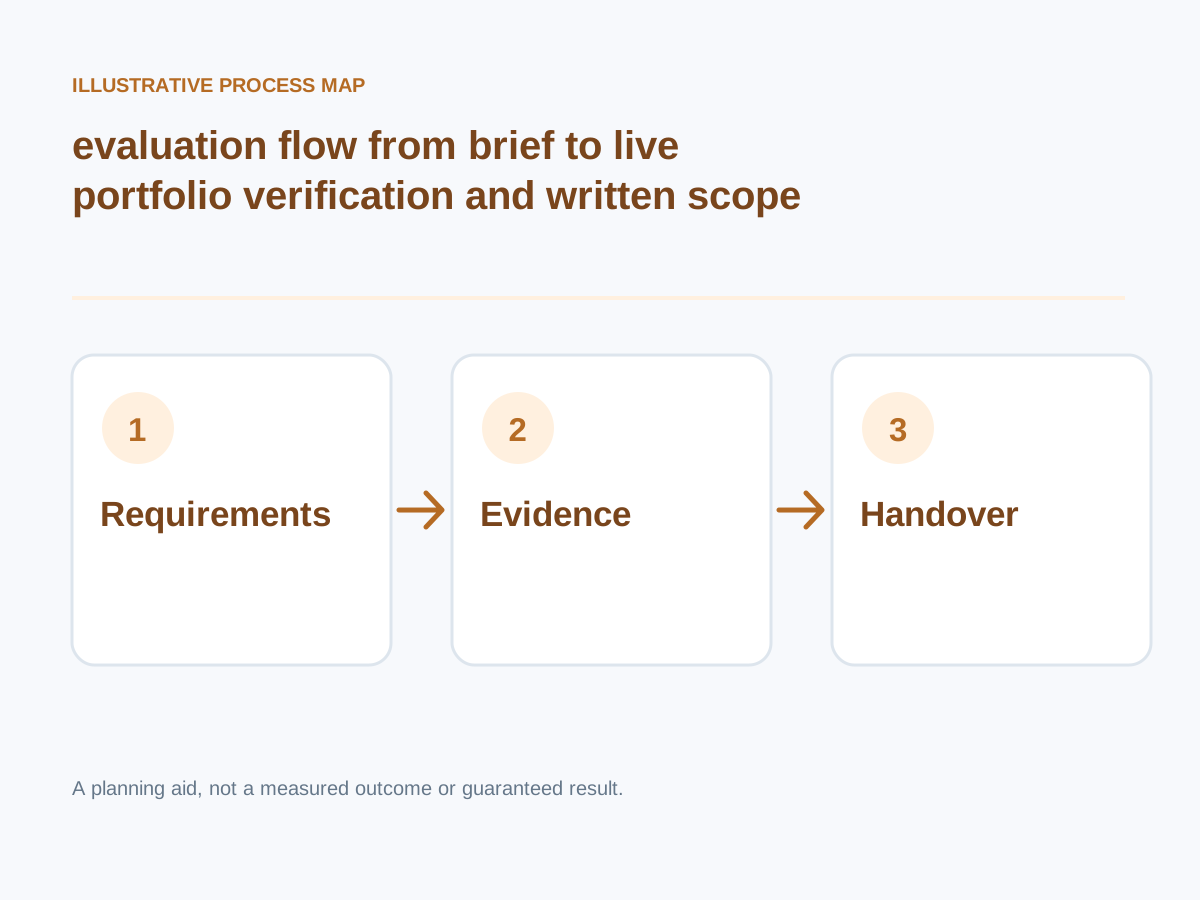
Conceptual illustration; not a client screenshot or measured result.
Test after-launch support
Understand bug-fix windows, update policies, uptime responsibilities, backups, restores and how enhancements are priced.
How to verify: Define what constitutes a defect versus a new feature.
Inspect live relevant examples
Request working sites close to your industry or functionality and permission to discuss contributions; stock mockups are not proof of completed projects.
How to verify: Test the portfolio examples on mobile and ask what the developer personally implemented.
Check communication and availability
Agree on the contact owner, update schedule, review rounds, issue escalation, and response expectations across time zones.
How to verify: Request a sample status update or project plan.
Get exact deliverables in a contract
Document pages, integrations, mobile behavior, design revisions, content responsibilities, analytics, SEO foundations, migration and support.
How to verify: Confirm each acceptance criterion can be tested.
Review security and data handling
Require least-privilege access, private credentials, backups, form spam protection and a plan to update dependencies.
How to verify: Request a launch security checklist appropriate for project risk.
Define desired business results
Put desired enquiries, sales, bookings, or operational improvements in writing and explain how success will be measured.
How to verify: Ask candidates to describe the user journey they would prioritize.
Make the decision with weighted criteria
Score technical fit, verified delivery, understanding, clarity, communication and total cost instead of ranking purely by price.
How to verify: Keep written rationale and unresolved risks before signing.
Assess the discovery process
A credible developer asks about audiences, content, sales process, constraints, technical dependencies and future ownership before naming a solution.
How to verify: Compare discovery questions across candidates rather than counting sales promises.
Next step: Prioritise the checks relevant to your project, record a baseline, test changes and consult the website development services or book a consultation for implementation support.
Decision Summary: Making Your Final Choice
Choosing a web developer in India requires balancing technical expertise with commercial understanding. If you need a partner who builds for speed, scalability, and conversion rather than just checking off feature boxes, your evaluation should focus on their planning framework, code ownership policies, and transparent communication.