The practical answer
Dental clinic website appointments: here is a practical decision framework.
A dental clinic website should help patients understand available services, know when to seek urgent care, find the practice and request an appointment with minimal uncertainty. It should not diagnose conditions online or make unsupported treatment promises to win clicks.
For dental clinic operators, the first decisions are match service pages to patient questions, make practice details obvious, and explain clinician credentials accurately. These are linked: solving the later step before checking the earlier one may waste time or create additional operating costs. A useful plan therefore defines how the customer journey should work and tests its critical assumptions before investing in more features.
Illustrative situation (not a client case study): A family dental practice may get search visits for braces or tooth pain but lose enquiries when location, opening hours, treatment explanations, practitioner credentials and booking options are hard to find.
Important limitation: Dental treatment is a health-sensitive subject. Clinical accuracy, licensed practitioner review, emergency instructions, patient privacy and local advertising standards require human professional verification.
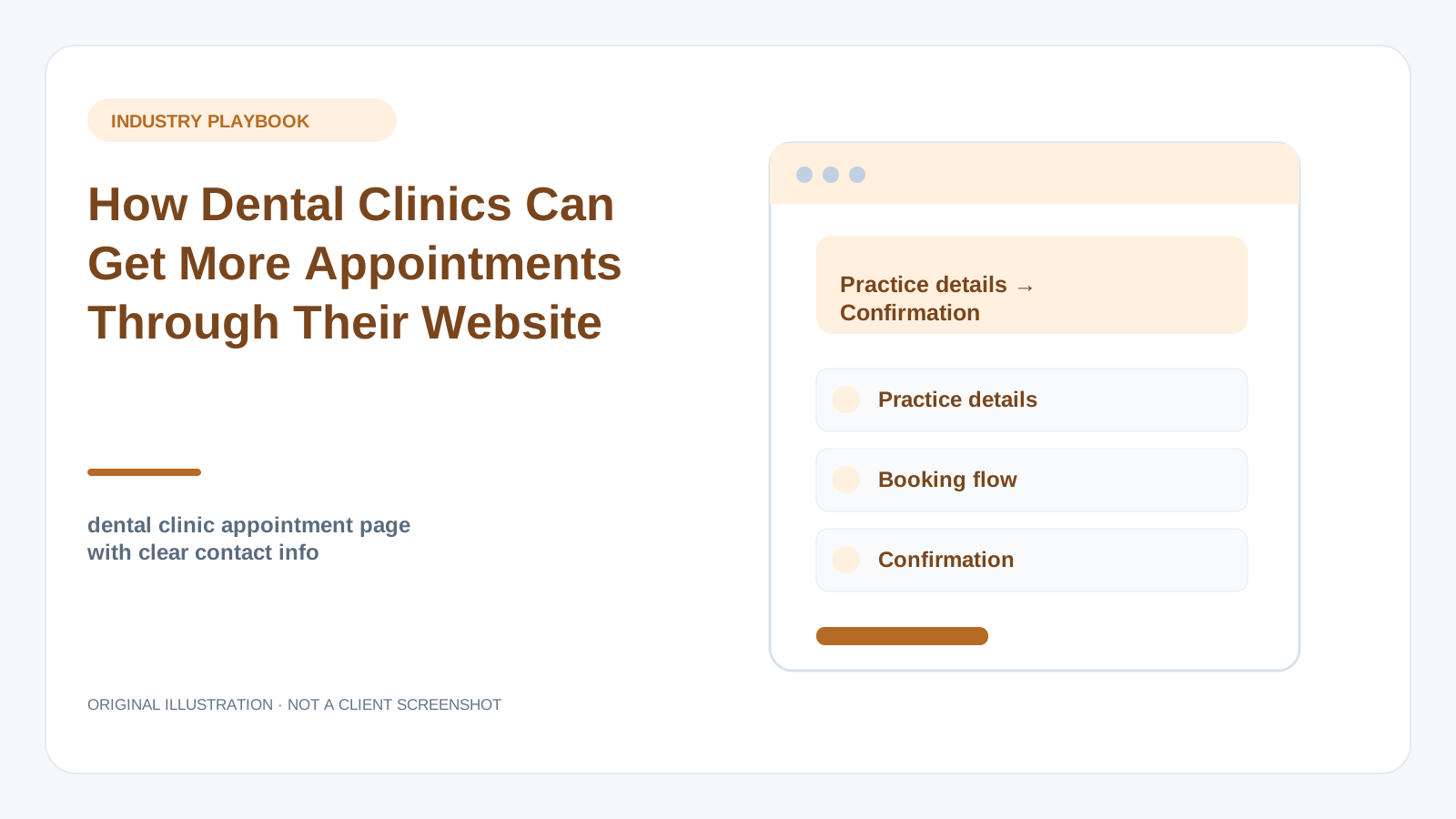
Original illustration—not a customer screenshot or measured result.
Before you change anything: a short diagnostic
A good investigation starts with match service pages to patient questions. Explain common appointment reasons, what to expect in consultation, and who can provide clinical advice. Its first proof point should be: Ask a licensed clinician to review medical statements.
Next review make practice details obvious. Show accurate address, accessible directions, phone number, operating hours and appointment policies. An observable check is: Verify contact and map links from a phone.
Third, examine explain clinician credentials accurately. Provide real qualifications, registration where applicable and clear roles without vague superlatives. Evidence for this check is: Confirm each detail with clinic management.
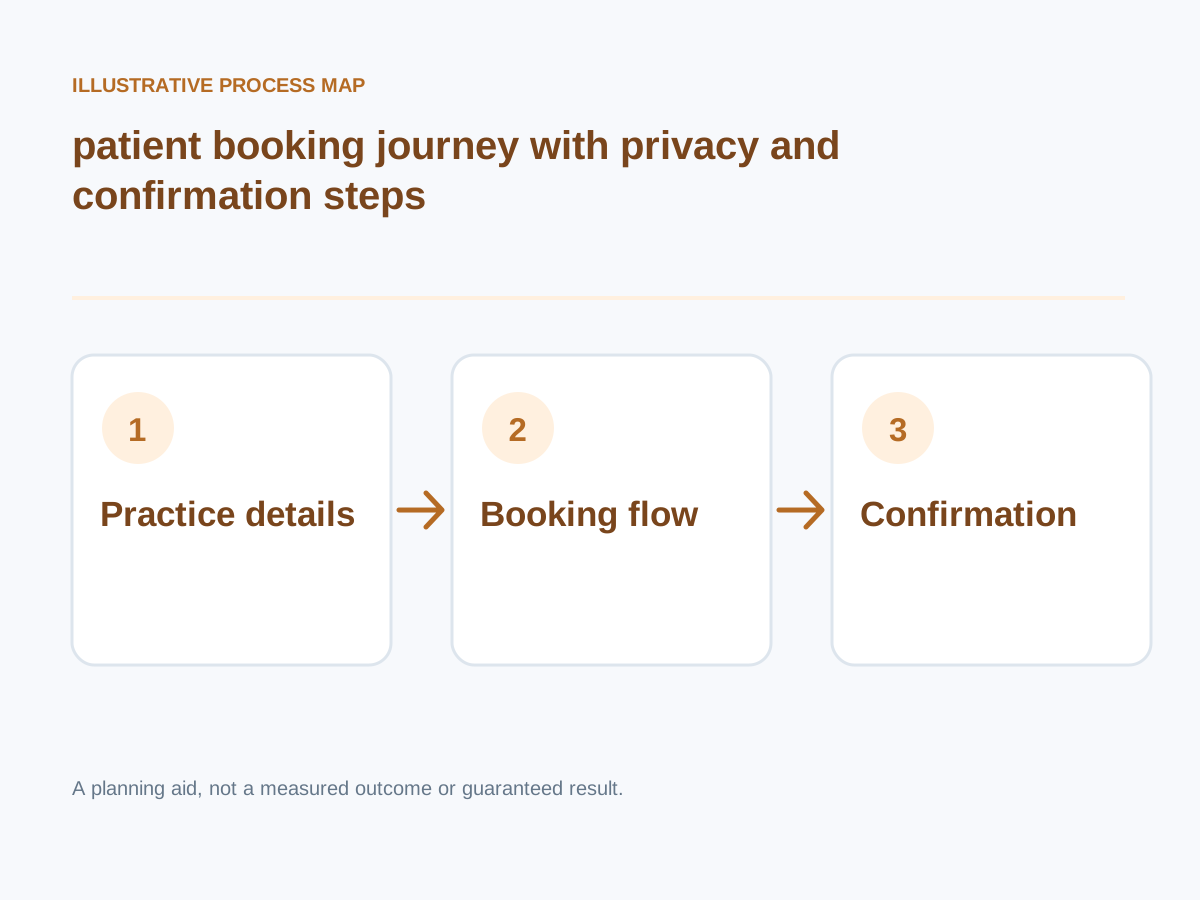
Conceptual workflow; adapt steps to your project.
Detailed step-by-step implementation plan
1. Match service pages to patient questions
Explain common appointment reasons, what to expect in consultation, and who can provide clinical advice.
How to verify: Ask a licensed clinician to review medical statements.
2. Make practice details obvious
Show accurate address, accessible directions, phone number, operating hours and appointment policies.
How to verify: Verify contact and map links from a phone.
3. Explain clinician credentials accurately
Provide real qualifications, registration where applicable and clear roles without vague superlatives.
How to verify: Confirm each detail with clinic management.
4. Offer a low-friction appointment request
Ask for limited scheduling details, explain response time, and avoid collecting unnecessary sensitive health history in ordinary forms.
How to verify: Submit a test booking and verify confirmation.
5. Clarify emergency boundaries
Distinguish routine appointment requests from urgent symptoms and provide locally appropriate professional contact guidance.
How to verify: Have clinical staff approve the notice.
6. Discuss fees responsibly
Explain whether consultations, estimates or payment plans are available without making generalized medical cost claims.
How to verify: Confirm all displayed policies with the practice.
7. Improve local discoverability
Keep contact data consistent, publish genuinely useful location information, and answer local patient access questions.
How to verify: Review discoverability and factual consistency.
8. Use authentic patient proof appropriately
Show consented reviews and photos only where permitted, avoiding misleading before/after guarantees.
How to verify: Check approvals and relevant professional rules.
9. Ensure accessible mobile use
Test readable fonts, appointment actions, maps and keyboard-accessible forms.
How to verify: Complete a booking on small devices.
10. Measure confirmed appointments
Reconcile website enquiries with appointments that were actually scheduled, rather than assuming every click is a patient.
How to verify: Review response times and appointment completion.
Worked decision scenario
Illustrative business situation: A family dental practice may get search visits for braces or tooth pain but lose enquiries when location, opening hours, treatment explanations, practitioner credentials and booking options are hard to find.
For this situation, begin with offer a low-friction appointment request: Ask for limited scheduling details, explain response time, and avoid collecting unnecessary sensitive health history in ordinary forms. This clarifies an early implementation dependency before committing to a large rewrite.
The next decision concerns clarify emergency boundaries: Distinguish routine appointment requests from urgent symptoms and provide locally appropriate professional contact guidance. In a practical project, translate this requirement into a demonstration that the owner, staff and end user can understand. The suggested acceptance check is: Have clinical staff approve the notice.
Finally, review discuss fees responsibly: Explain whether consultations, estimates or payment plans are available without making generalized medical cost claims. This example is hypothetical, not a claimed client engagement. No before-and-after revenue or search result is implied. A real case study would require prior measurements, documented implementation, permission and an accurate description of what happened.
Measurement plan: what to track and what not to assume
Measure confirmed dental appointment requests and whether patients can find accurate practice contact information. Ask a qualified clinician to review any clinical explanations before publication.
Start with these practical evidence points: use authentic patient proof appropriately — Check approvals and relevant professional rules. Next examine ensure accessible mobile use — Complete a booking on small devices. Then assess measure confirmed appointments — Review response times and appointment completion.
Common mistakes and safer alternatives
- Skipping make practice details obvious. Corrective approach: Show accurate address, accessible directions, phone number, operating hours and appointment policies. To know whether the fix works, verify contact and map links from a phone.
- Skipping offer a low-friction appointment request. Corrective approach: Ask for limited scheduling details, explain response time, and avoid collecting unnecessary sensitive health history in ordinary forms. To know whether the fix works, submit a test booking and verify confirmation.
- Skipping discuss fees responsibly. Corrective approach: Explain whether consultations, estimates or payment plans are available without making generalized medical cost claims. To know whether the fix works, confirm all displayed policies with the practice.
- Skipping use authentic patient proof appropriately. Corrective approach: Show consented reviews and photos only where permitted, avoiding misleading before/after guarantees. To know whether the fix works, check approvals and relevant professional rules.
- Skipping measure confirmed appointments. Corrective approach: Reconcile website enquiries with appointments that were actually scheduled, rather than assuming every click is a patient. To know whether the fix works, review response times and appointment completion.
A practical four-week execution roadmap
Week 1 — Diagnose and establish requirements: Focus on match service pages to patient questions, make practice details obvious, explain clinician credentials accurately. Ask a licensed clinician to review medical statements.; Verify contact and map links from a phone.
Week 2 — Prototype the highest-impact change: Focus on offer a low-friction appointment request, clarify emergency boundaries. Submit a test booking and verify confirmation.; Have clinical staff approve the notice.
Week 3 — Implement and validate: Focus on discuss fees responsibly, improve local discoverability, use authentic patient proof appropriately. Confirm all displayed policies with the practice.; Review discoverability and factual consistency.
Week 4 — Verify decisions: Revisit these priorities: ensure accessible mobile use, measure confirmed appointments. Complete a booking on small devices. Review response times and appointment completion. Document the date, measurement method and any unresolved risks.
Final checklist before hiring or implementing
- Ask a licensed clinician to review medical statements.
- Verify contact and map links from a phone.
- Confirm each detail with clinic management.
- Submit a test booking and verify confirmation.
- Have clinical staff approve the notice.
- Confirm all displayed policies with the practice.
- Review discoverability and factual consistency.
- Check approvals and relevant professional rules.
- Complete a booking on small devices.
- Review response times and appointment completion.
Want help implementing this?
Need implementation support? If you want to build a clearer clinic booking journey, review my primary development service and related specialist service. You can also try the free website-planning tools before discussing scope. Book a free consultation to discuss your specific requirements; results depend on traffic, implementation and the business context.
Reference material and transparency
Documentation reviewed: 30 October 2026.
-
Verified technical fact: W3C's accessible-forms guidance calls for clear labels, instructions and input validation. Client-side validation alone is not a security control. W3C WAI
-
Verified technical fact: Google's people-first guidance asks creators to provide original, useful information rather than pages built mainly to capture search traffic. Google Search Central
-
Verified technical fact: W3C's image-alt guidance distinguishes informative images from decorative images and complex diagrams, which may require surrounding text explanations. W3C WAI
Clinical review: A licensed dental professional must approve any clinical/patient-safety wording before publication. Additional checked source (30 October 2026): India's National Dental Commission Act, 2023 provides the statutory regulatory framework for dentistry; it is not a medical-treatment guide or marketing permission. Official primary source
Scope / limits: A licensed dental professional and jurisdiction-aware legal reviewer must approve any treatment, patient privacy or dental advertising claims.
Evidence boundary: The official links below substantiate these specific platform/technical facts, not the article's illustrative scenarios, a guaranteed traffic/sales outcome, or any claim about an actual client.