The practical answer
Salon website online booking: here is a practical decision framework.
A salon website should make three decisions easy: select a service, understand the time and price context, and book an available appointment. Many salons rely on social profiles where services, availability and policies are scattered; a website can create a clearer owned booking path.
For salon owners and stylists, the first decisions are create a service menu buyers understand, define appointment capacity, and choose a scheduling workflow. These are linked: solving the later step before checking the earlier one may waste time or create additional operating costs. A useful plan therefore defines how the customer journey should work and tests its critical assumptions before investing in more features.
Illustrative situation (not a client case study): A multi-stylist salon needs a booking system that respects service duration, staff availability and appointment buffers. A generic contact form may not be enough when booking volume increases.
Important limitation: Do not claim appointments are confirmed until the scheduling system has actually reserved a slot. Payment and cancellation rules must match real operations.
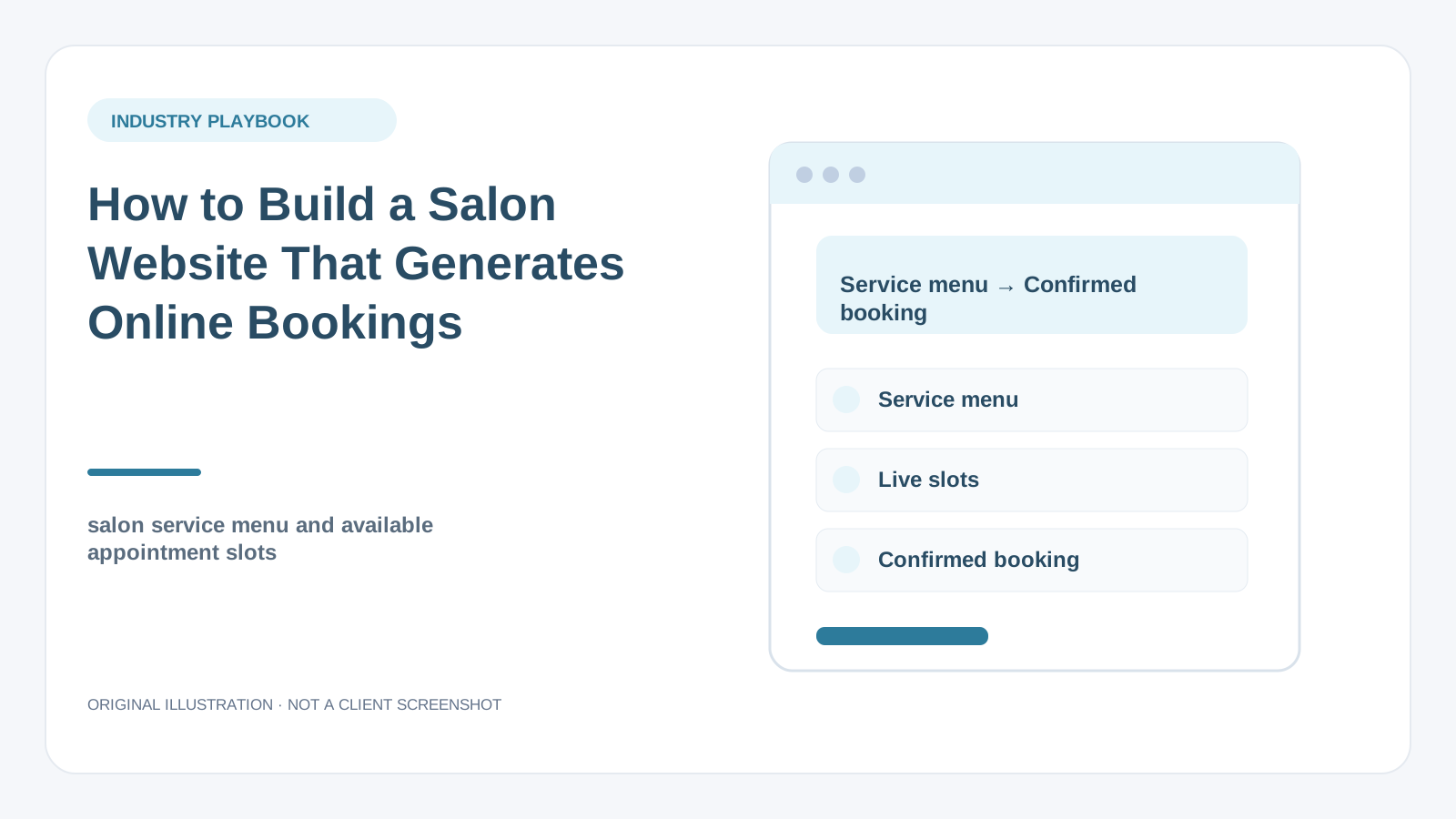
Original illustration—not a customer screenshot or measured result.
Before you change anything: a short diagnostic
A good investigation starts with create a service menu buyers understand. List cuts, coloring, treatments and packages with duration, starting prices or estimate rules, and what is excluded. Its first proof point should be: Ask a customer to choose the correct appointment type.
Next review define appointment capacity. Set staff skills, shift hours, buffers, breaks and simultaneous resource needs such as treatment rooms. An observable check is: Test conflicts and overlapping bookings.
Third, examine choose a scheduling workflow. Compare booking tools on calendars, confirmations, cancellations, no-shows, deposits and data ownership. Evidence for this check is: Complete an appointment from selection to confirmation.
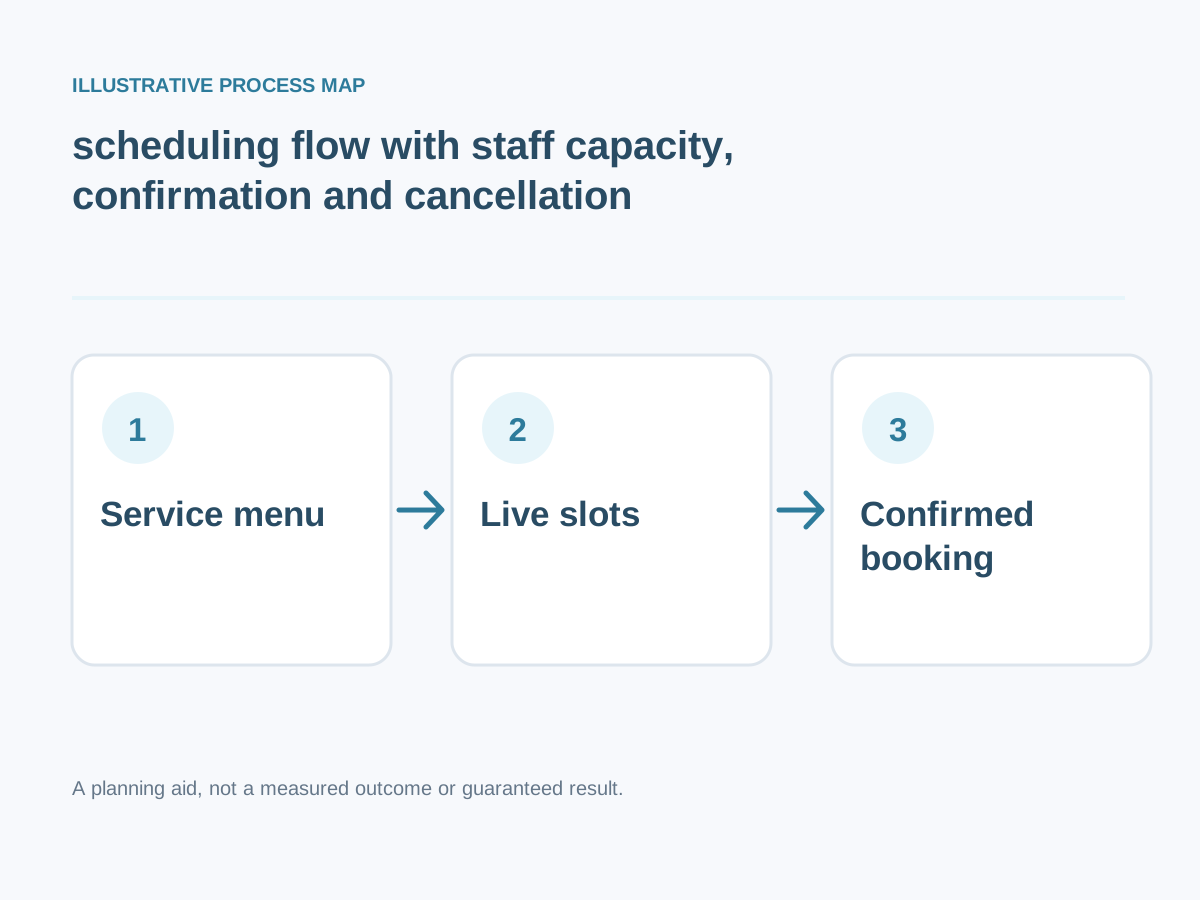
Conceptual workflow; adapt steps to your project.
Detailed step-by-step implementation plan
1. Create a service menu buyers understand
List cuts, coloring, treatments and packages with duration, starting prices or estimate rules, and what is excluded.
How to verify: Ask a customer to choose the correct appointment type.
2. Define appointment capacity
Set staff skills, shift hours, buffers, breaks and simultaneous resource needs such as treatment rooms.
How to verify: Test conflicts and overlapping bookings.
3. Choose a scheduling workflow
Compare booking tools on calendars, confirmations, cancellations, no-shows, deposits and data ownership.
How to verify: Complete an appointment from selection to confirmation.
4. Show portfolios truthfully
Use permissioned images of actual work with relevant descriptions; avoid implying unrealistic guaranteed results.
How to verify: Check captions, consent and service association.
5. Make mobile booking primary
Put Book Appointment where users expect it and minimize steps between service choice and available slot.
How to verify: Time the journey on a phone.
6. Handle deposits transparently
Clearly state whether a deposit applies, when it is refundable and what happens if appointments change.
How to verify: Test cancellation and payment-failure workflows.
7. Provide salon-specific practical details
Add location, parking, accessibility, arrival time, preparation requirements and contact information.
How to verify: Verify with front-desk staff.
8. Create useful treatment content
Explain service suitability, upkeep and aftercare only within staff expertise, with clear limitations.
How to verify: Have senior stylists review technical advice.
9. Connect scheduling and reminders
Prevent double booking and send respectful confirmations and reminders with consent-aware communication.
How to verify: Reconcile reminders with booked appointments.
10. Track completed services
Measure booking requests, confirmed appointments, arrivals and repeat visits rather than only page views.
How to verify: Compare calendar data with website events.
Worked decision scenario
Illustrative business situation: A multi-stylist salon needs a booking system that respects service duration, staff availability and appointment buffers. A generic contact form may not be enough when booking volume increases.
For this situation, begin with show portfolios truthfully: Use permissioned images of actual work with relevant descriptions; avoid implying unrealistic guaranteed results. This clarifies an early implementation dependency before committing to a large rewrite.
The next decision concerns make mobile booking primary: Put Book Appointment where users expect it and minimize steps between service choice and available slot. In a practical project, translate this requirement into a demonstration that the owner, staff and end user can understand. The suggested acceptance check is: Time the journey on a phone.
Finally, review handle deposits transparently: Clearly state whether a deposit applies, when it is refundable and what happens if appointments change. This example is hypothetical, not a claimed client engagement. No before-and-after revenue or search result is implied. A real case study would require prior measurements, documented implementation, permission and an accurate description of what happened.
Measurement plan: what to track and what not to assume
Track booking completion, cancellation and rebooking against staff availability and actual calendar records. A website is useful only if its online slots reflect real salon capacity.
Start with these practical evidence points: create useful treatment content — Have senior stylists review technical advice. Next examine connect scheduling and reminders — Reconcile reminders with booked appointments. Then assess track completed services — Compare calendar data with website events.
Common mistakes and safer alternatives
- Skipping define appointment capacity. Corrective approach: Set staff skills, shift hours, buffers, breaks and simultaneous resource needs such as treatment rooms. To know whether the fix works, test conflicts and overlapping bookings.
- Skipping show portfolios truthfully. Corrective approach: Use permissioned images of actual work with relevant descriptions; avoid implying unrealistic guaranteed results. To know whether the fix works, check captions, consent and service association.
- Skipping handle deposits transparently. Corrective approach: Clearly state whether a deposit applies, when it is refundable and what happens if appointments change. To know whether the fix works, test cancellation and payment-failure workflows.
- Skipping create useful treatment content. Corrective approach: Explain service suitability, upkeep and aftercare only within staff expertise, with clear limitations. To know whether the fix works, have senior stylists review technical advice.
- Skipping track completed services. Corrective approach: Measure booking requests, confirmed appointments, arrivals and repeat visits rather than only page views. To know whether the fix works, compare calendar data with website events.
A practical four-week execution roadmap
Week 1 — Diagnose and establish requirements: Focus on create a service menu buyers understand, define appointment capacity, choose a scheduling workflow. Ask a customer to choose the correct appointment type.; Test conflicts and overlapping bookings.
Week 2 — Prototype the highest-impact change: Focus on show portfolios truthfully, make mobile booking primary. Check captions, consent and service association.; Time the journey on a phone.
Week 3 — Implement and validate: Focus on handle deposits transparently, provide salon-specific practical details, create useful treatment content. Test cancellation and payment-failure workflows.; Verify with front-desk staff.
Week 4 — Verify decisions: Revisit these priorities: connect scheduling and reminders, track completed services. Reconcile reminders with booked appointments. Compare calendar data with website events. Document the date, measurement method and any unresolved risks.
Final checklist before hiring or implementing
- Ask a customer to choose the correct appointment type.
- Test conflicts and overlapping bookings.
- Complete an appointment from selection to confirmation.
- Check captions, consent and service association.
- Time the journey on a phone.
- Test cancellation and payment-failure workflows.
- Verify with front-desk staff.
- Have senior stylists review technical advice.
- Reconcile reminders with booked appointments.
- Compare calendar data with website events.
Want help implementing this?
Need implementation support? If you want to make your salon bookings more reliable, review my primary development service and related specialist service. You can also try the free website-planning tools before discussing scope. Book a free consultation to discuss your specific requirements; results depend on traffic, implementation and the business context.
Reference material and transparency
Documentation reviewed: 30 October 2026.
-
Verified technical fact: W3C's accessible-forms guidance calls for clear labels, instructions and input validation. Client-side validation alone is not a security control. W3C WAI
-
Verified technical fact: Google uses mobile page content for mobile-first indexing and recommends responsive design because it is generally easiest to implement and maintain. Google Search Central
-
Verified technical fact: W3C's image-alt guidance distinguishes informative images from decorative images and complex diagrams, which may require surrounding text explanations. W3C WAI
Local compliance: Verify property, appointment, restaurant, hospitality and privacy requirements with the actual business and applicable local rules. Additional checked source (30 October 2026): W3C guidance supports explicitly labeled, accessible booking forms; a form submission does not independently establish that an appointment slot has been reserved. Official primary source
Scope / limits: Actual slot availability, cancellation windows, deposits and staff capacity must be checked against the salon's booking system.
Evidence boundary: The official links below substantiate these specific platform/technical facts, not the article's illustrative scenarios, a guaranteed traffic/sales outcome, or any claim about an actual client.