The practical answer
Shopify SEO requires clear product information, navigable collections, useful content, accessible pages and trustworthy technical settings. No single plugin or schema snippet can guarantee search rankings. Start with what shoppers need and what Google can actually crawl.
For Shopify merchants, the first decisions are identify real buyer queries, improve product titles and descriptions, and build collections around customer logic. These are linked: solving the later step before checking the earlier one may waste time or create additional operating costs. A useful plan therefore defines how the customer journey should work and tests its critical assumptions before investing in more features.
Illustrative situation (not a client case study): For a jewelry store, a well-organized collection hierarchy and genuinely useful size/material descriptions will help customers navigate more than hundreds of near-identical keyword pages.
Important limitation: Do not publish mass-generated city or product variants solely to capture search queries. Google warns against scaled unhelpful content and doorway-like duplication.
Original illustration—not a customer screenshot or measured result.
Before you change anything: a short diagnostic
A good investigation starts with identify real buyer queries. Group searches into product discovery, comparisons, how-to questions and post-purchase support. Its first proof point should be: Map each intent to a genuinely useful page.
Next review improve product titles and descriptions. Use the real product name, materials, sizes, variations, care instructions and differentiators; avoid duplicated manufacturer copy. An observable check is: Review whether the page answers actual pre-purchase questions.
Third, examine build collections around customer logic. Organize by type, material, purpose or fit without creating thin near-duplicate collection URLs. Evidence for this check is: Test navigation with a first-time shopper.
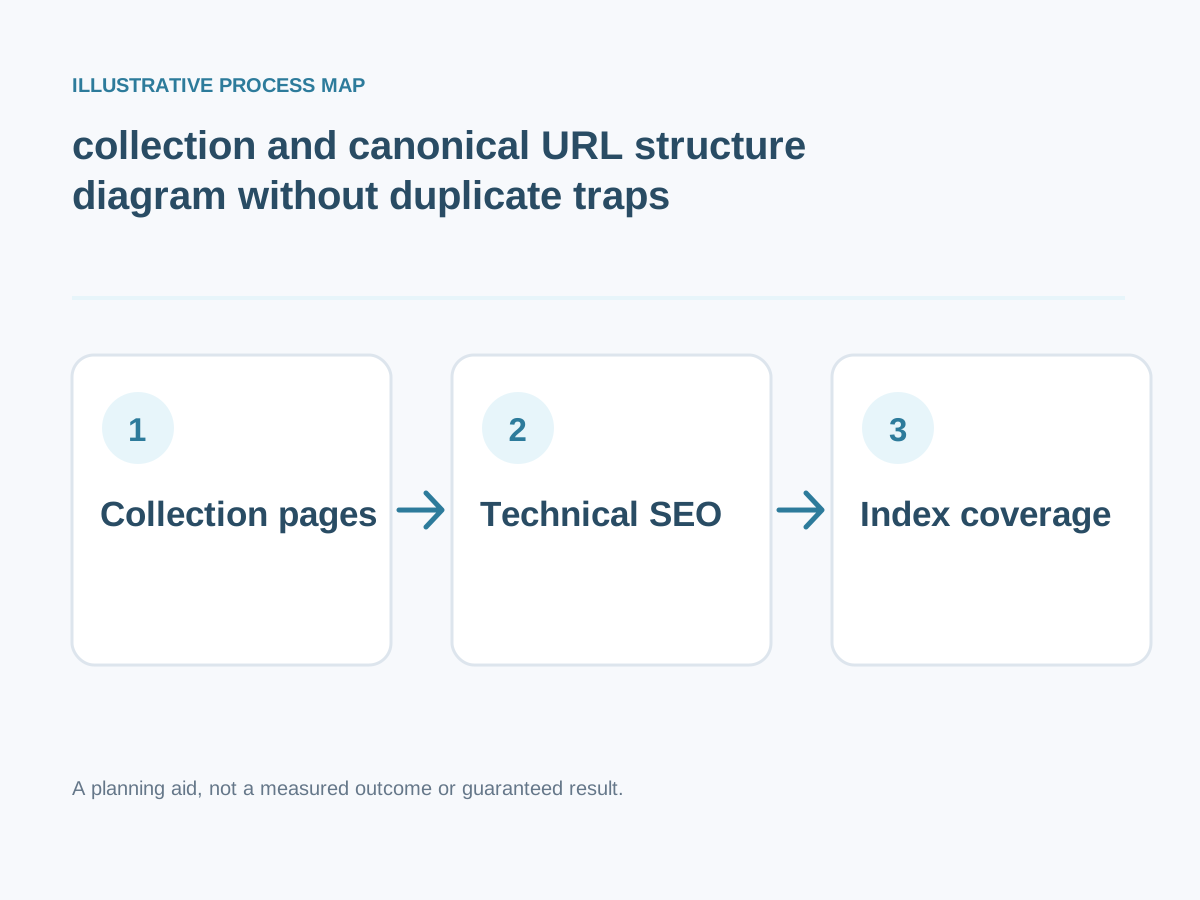
Conceptual workflow; adapt steps to your project.
Detailed step-by-step implementation plan
1. Identify real buyer queries
Group searches into product discovery, comparisons, how-to questions and post-purchase support.
How to verify: Map each intent to a genuinely useful page.
2. Improve product titles and descriptions
Use the real product name, materials, sizes, variations, care instructions and differentiators; avoid duplicated manufacturer copy.
How to verify: Review whether the page answers actual pre-purchase questions.
3. Build collections around customer logic
Organize by type, material, purpose or fit without creating thin near-duplicate collection URLs.
How to verify: Test navigation with a first-time shopper.
4. Manage variants and canonicalization
Inspect how options, filters and duplicate paths render and whether canonical tags represent the intended primary URLs.
How to verify: Crawl sample products with variants and filters.
5. Enhance product media and alt text
Use accurate images, appropriate file delivery and meaningful descriptions when images convey content.
How to verify: Check responsive output and product image accessibility.
6. Implement structured data accurately
Provide valid eligible product information consistent with visible price, availability, offers and reviews.
How to verify: Validate markup using appropriate Google tools.
7. Improve internal linking
Connect relevant collections, products, guides, FAQs and category navigation in helpful contexts.
How to verify: Crawl important product URLs from top-level navigation.
8. Publish genuinely useful buying guides
Answer comparisons, compatibility, materials, sizing, maintenance or selection problems with expert detail.
How to verify: Require sources and original examples or demonstrations.
9. Monitor technical performance
Check robots, sitemaps, index coverage, page experience, redirects and broken links.
How to verify: Track Search Console issues and resolve verified causes.
10. Measure commercial outcomes
Look beyond keyword rankings to product discovery, qualified visits, orders and customer experience.
How to verify: Reconcile landing pages and sales outcomes where attribution permits.
Worked decision scenario
Illustrative business situation: For a jewelry store, a well-organized collection hierarchy and genuinely useful size/material descriptions will help customers navigate more than hundreds of near-identical keyword pages.
For this situation, begin with manage variants and canonicalization: Inspect how options, filters and duplicate paths render and whether canonical tags represent the intended primary URLs. This clarifies an early implementation dependency before committing to a large rewrite.
The next decision concerns enhance product media and alt text: Use accurate images, appropriate file delivery and meaningful descriptions when images convey content. In a practical project, translate this requirement into a demonstration that the owner, staff and end user can understand. The suggested acceptance check is: Check responsive output and product image accessibility.
Finally, review implement structured data accurately: Provide valid eligible product information consistent with visible price, availability, offers and reviews. This example is hypothetical, not a claimed client engagement. No before-and-after revenue or search result is implied. A real case study would require prior measurements, documented implementation, permission and an accurate description of what happened.
Measurement plan: what to track and what not to assume
Measure indexed product and collection visibility with Search Console and relate it to relevant traffic and purchases. Verify template changes do not create duplicate URLs or crawlable faceted combinations.
Start with these practical evidence points: publish genuinely useful buying guides — Require sources and original examples or demonstrations. Next examine monitor technical performance — Track Search Console issues and resolve verified causes. Then assess measure commercial outcomes — Reconcile landing pages and sales outcomes where attribution permits.
Common mistakes and safer alternatives
- Skipping improve product titles and descriptions. Corrective approach: Use the real product name, materials, sizes, variations, care instructions and differentiators; avoid duplicated manufacturer copy. To know whether the fix works, review whether the page answers actual pre-purchase questions.
- Skipping manage variants and canonicalization. Corrective approach: Inspect how options, filters and duplicate paths render and whether canonical tags represent the intended primary URLs. To know whether the fix works, crawl sample products with variants and filters.
- Skipping implement structured data accurately. Corrective approach: Provide valid eligible product information consistent with visible price, availability, offers and reviews. To know whether the fix works, validate markup using appropriate Google tools.
- Skipping publish genuinely useful buying guides. Corrective approach: Answer comparisons, compatibility, materials, sizing, maintenance or selection problems with expert detail. To know whether the fix works, require sources and original examples or demonstrations.
- Skipping measure commercial outcomes. Corrective approach: Look beyond keyword rankings to product discovery, qualified visits, orders and customer experience. To know whether the fix works, reconcile landing pages and sales outcomes where attribution permits.
A practical four-week execution roadmap
Week 1 — Diagnose and establish requirements: Focus on identify real buyer queries, improve product titles and descriptions, build collections around customer logic. Map each intent to a genuinely useful page.; Review whether the page answers actual pre-purchase questions.
Week 2 — Prototype the highest-impact change: Focus on manage variants and canonicalization, enhance product media and alt text. Crawl sample products with variants and filters.; Check responsive output and product image accessibility.
Week 3 — Implement and validate: Focus on implement structured data accurately, improve internal linking, publish genuinely useful buying guides. Validate markup using appropriate Google tools.; Crawl important product URLs from top-level navigation.
Week 4 — Verify decisions: Revisit these priorities: monitor technical performance, measure commercial outcomes. Track Search Console issues and resolve verified causes. Reconcile landing pages and sales outcomes where attribution permits. Document the date, measurement method and any unresolved risks.
Final checklist before hiring or implementing
- Map each intent to a genuinely useful page.
- Review whether the page answers actual pre-purchase questions.
- Test navigation with a first-time shopper.
- Crawl sample products with variants and filters.
- Check responsive output and product image accessibility.
- Validate markup using appropriate Google tools.
- Crawl important product URLs from top-level navigation.
- Require sources and original examples or demonstrations.
- Track Search Console issues and resolve verified causes.
- Reconcile landing pages and sales outcomes where attribution permits.
Want help implementing this?
Need implementation support? If you want to improve Shopify technical SEO foundations, review my primary development service and related specialist service. You can also try the free website-planning tools before discussing scope. Book a free consultation to discuss your specific requirements; results depend on traffic, implementation and the business context.
Reference material and transparency
Documentation reviewed: 30 October 2026.
-
Verified technical fact: Google advises consistent ecommerce product-variant and canonical URLs; duplicate faceted or parameter URLs can cause crawl and indexing problems. Google Search Central
-
Verified technical fact: Valid structured data can make a page eligible for certain rich results, but Google explicitly does not guarantee a rich-result display. Google Search Central
-
Verified technical fact: Google's ecommerce guidance explains how crawlable internal linking, navigation and structured product information help search systems discover and interpret online store pages. Google Search Central
Additional checked source (30 October 2026): Google's structured data policies explicitly state that compliant markup does not guarantee appearance as a rich result. Official primary source
Scope / limits: Actual Shopify collection crawlability, selected canonical URLs, indexing and rankings require Search Console and live product URLs.
Evidence boundary: The official links below substantiate these specific platform/technical facts, not the article's illustrative scenarios, a guaranteed traffic/sales outcome, or any claim about an actual client.