The practical answer
Fashion ecommerce cart abandonment: here is a practical decision framework.
Fashion shoppers often abandon carts because size uncertainty, shipping surprises, return restrictions, slow mobile checkout or limited trust make the final decision difficult. Abandoned carts also include normal comparison shopping, so diagnose patterns before assuming the checkout is broken.
For fashion and apparel D2C founders, the first decisions are distinguish normal browsing from checkout failure, improve fit and sizing confidence, and clarify fabric and product expectations. These are linked: solving the later step before checking the earlier one may waste time or create additional operating costs. A useful plan therefore defines how the customer journey should work and tests its critical assumptions before investing in more features.
Illustrative situation (not a client case study): An apparel store might get many carts for a new collection but low completed orders because size information is difficult to understand and the delivery estimate appears only after the address form.
Important limitation: No universal cart abandonment statistic or recovered-revenue claim is used here. Results depend on customer intent, product price, channel mix, mobile behavior and retailer policies.
Original illustration—not a customer screenshot or measured result.
Before you change anything: a short diagnostic
A good investigation starts with distinguish normal browsing from checkout failure. Segment add-to-cart, checkout-start and completed-order events by channel, device and new versus returning users. Its first proof point should be: Reconcile analytics stages with actual order records.
Next review improve fit and sizing confidence. Provide measurements, size guidance, fit notes, model dimensions where permitted and clear exchanges. An observable check is: Review size-related returns and support messages.
Third, examine clarify fabric and product expectations. Show material, lining, opacity, care, color variation and real-life detail photos rather than only editorial shots. Evidence for this check is: Ask buyers whether product expectations are clear.
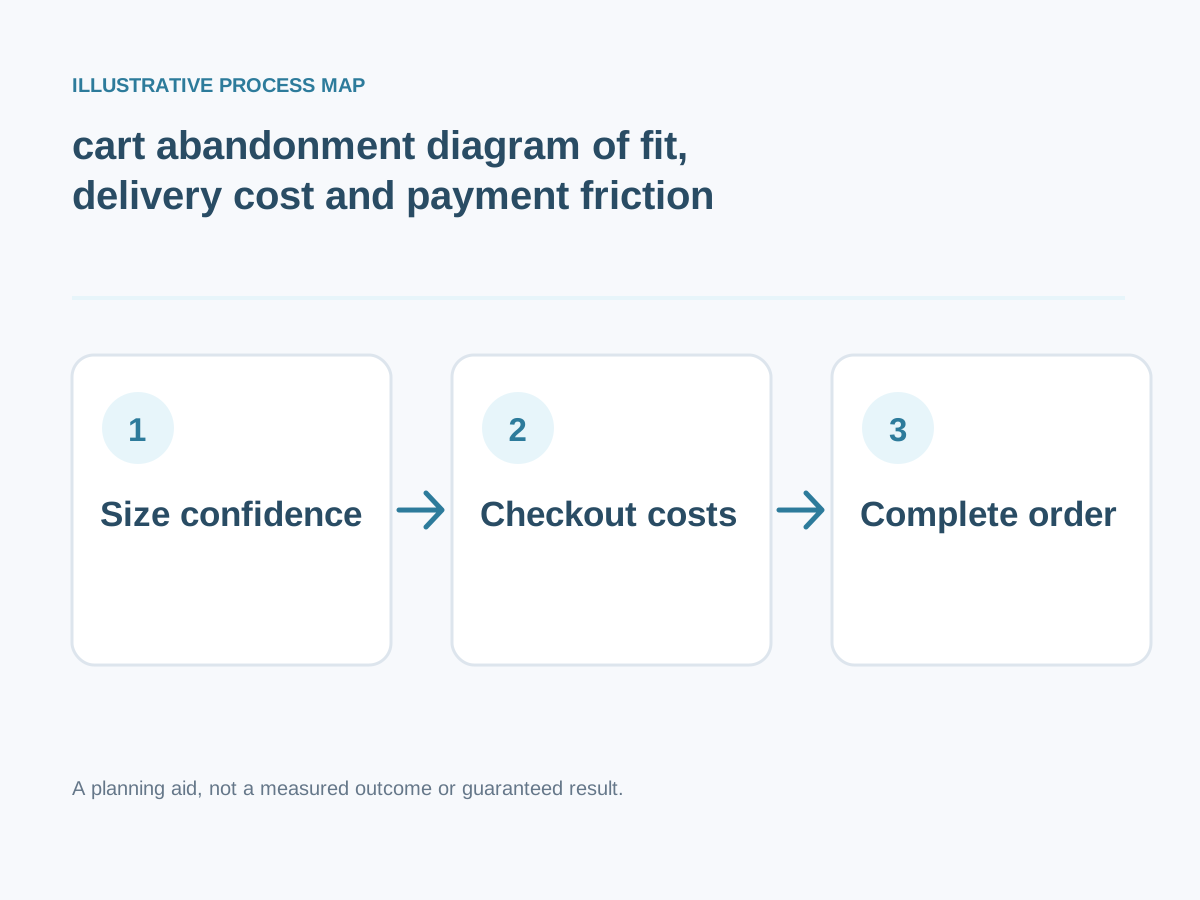
Conceptual workflow; adapt steps to your project.
Detailed step-by-step implementation plan
1. Distinguish normal browsing from checkout failure
Segment add-to-cart, checkout-start and completed-order events by channel, device and new versus returning users.
How to verify: Reconcile analytics stages with actual order records.
2. Improve fit and sizing confidence
Provide measurements, size guidance, fit notes, model dimensions where permitted and clear exchanges.
How to verify: Review size-related returns and support messages.
3. Clarify fabric and product expectations
Show material, lining, opacity, care, color variation and real-life detail photos rather than only editorial shots.
How to verify: Ask buyers whether product expectations are clear.
4. Expose shipping and taxes early
Show delivery coverage, threshold fees, taxes and handling times before the final payment step.
How to verify: Compare product-page promises with checkout totals.
5. Make stock and variants reliable
Ensure selected sizes and colors remain accurate as customers move from listing to cart.
How to verify: Test out-of-stock transitions and promotions.
6. Simplify guest checkout
Reduce unnecessary account creation and form fields while preserving required compliance and payment information.
How to verify: Complete checkout on phones with realistic addresses.
7. Use trustworthy payment methods
Offer supported secure options with clear failure recovery, refunds and order confirmation.
How to verify: Simulate payment success and failure.
8. Handle offers transparently
Avoid fake countdowns, false scarcity or confusing coupon rules.
How to verify: Check discount conditions against actual cart totals.
9. Set up respectful cart recovery
Send reminders only with appropriate consent, accurate item details and a clear unsubscribe or preference mechanism.
How to verify: Review recovery orders and complaints.
10. Measure customer-quality outcomes
Track completed orders, return rates, margin, repeat purchase and support load, not just recovered checkout sessions.
How to verify: Compare changes across comparable periods.
Worked decision scenario
Illustrative business situation: An apparel store might get many carts for a new collection but low completed orders because size information is difficult to understand and the delivery estimate appears only after the address form.
For this situation, begin with expose shipping and taxes early: Show delivery coverage, threshold fees, taxes and handling times before the final payment step. This clarifies an early implementation dependency before committing to a large rewrite.
The next decision concerns make stock and variants reliable: Ensure selected sizes and colors remain accurate as customers move from listing to cart. In a practical project, translate this requirement into a demonstration that the owner, staff and end user can understand. The suggested acceptance check is: Test out-of-stock transitions and promotions.
Finally, review simplify guest checkout: Reduce unnecessary account creation and form fields while preserving required compliance and payment information. This example is hypothetical, not a claimed client engagement. No before-and-after revenue or search result is implied. A real case study would require prior measurements, documented implementation, permission and an accurate description of what happened.
Measurement plan: what to track and what not to assume
Compare checkout completions, sizing questions, product returns, payment failures and shipping complaints by product category. Segment new versus returning shoppers to avoid misleading averages.
Start with these practical evidence points: handle offers transparently — Check discount conditions against actual cart totals. Next examine set up respectful cart recovery — Review recovery orders and complaints. Then assess measure customer-quality outcomes — Compare changes across comparable periods.
Common mistakes and safer alternatives
- Skipping improve fit and sizing confidence. Corrective approach: Provide measurements, size guidance, fit notes, model dimensions where permitted and clear exchanges. To know whether the fix works, review size-related returns and support messages.
- Skipping expose shipping and taxes early. Corrective approach: Show delivery coverage, threshold fees, taxes and handling times before the final payment step. To know whether the fix works, compare product-page promises with checkout totals.
- Skipping simplify guest checkout. Corrective approach: Reduce unnecessary account creation and form fields while preserving required compliance and payment information. To know whether the fix works, complete checkout on phones with realistic addresses.
- Skipping handle offers transparently. Corrective approach: Avoid fake countdowns, false scarcity or confusing coupon rules. To know whether the fix works, check discount conditions against actual cart totals.
- Skipping measure customer-quality outcomes. Corrective approach: Track completed orders, return rates, margin, repeat purchase and support load, not just recovered checkout sessions. To know whether the fix works, compare changes across comparable periods.
A practical four-week execution roadmap
Week 1 — Diagnose and establish requirements: Focus on distinguish normal browsing from checkout failure, improve fit and sizing confidence, clarify fabric and product expectations. Reconcile analytics stages with actual order records.; Review size-related returns and support messages.
Week 2 — Prototype the highest-impact change: Focus on expose shipping and taxes early, make stock and variants reliable. Compare product-page promises with checkout totals.; Test out-of-stock transitions and promotions.
Week 3 — Implement and validate: Focus on simplify guest checkout, use trustworthy payment methods, handle offers transparently. Complete checkout on phones with realistic addresses.; Simulate payment success and failure.
Week 4 — Verify decisions: Revisit these priorities: set up respectful cart recovery, measure customer-quality outcomes. Review recovery orders and complaints. Compare changes across comparable periods. Document the date, measurement method and any unresolved risks.
Final checklist before hiring or implementing
- Reconcile analytics stages with actual order records.
- Review size-related returns and support messages.
- Ask buyers whether product expectations are clear.
- Compare product-page promises with checkout totals.
- Test out-of-stock transitions and promotions.
- Complete checkout on phones with realistic addresses.
- Simulate payment success and failure.
- Check discount conditions against actual cart totals.
- Review recovery orders and complaints.
- Compare changes across comparable periods.
Want help implementing this?
Need implementation support? If you want to lower fashion cart abandonment, review my primary development service and related specialist service. You can also try the free website-planning tools before discussing scope. Book a free consultation to discuss your specific requirements; results depend on traffic, implementation and the business context.
Reference material and transparency
Documentation reviewed: 30 October 2026.
-
Verified technical fact: Shopify guidance requires obtaining appropriate customer agreement before promotional email; consent configuration and local-law duties still require merchant review. Shopify Help Center
-
Verified technical fact: Shopify's checkout shipping options depend on store shipping configuration and the buyer's shipping address; merchants can verify them with test orders. Shopify Help Center
-
Verified technical fact: W3C's accessible-forms guidance calls for clear labels, instructions and input validation. Client-side validation alone is not a security control. W3C WAI
Additional checked source (30 October 2026): Shopify's newer abandoned checkout recovery guidance ties outreach to configured automations and supported customer email permissions. Official primary source
Scope / limits: A fashion retailer's size-chart effectiveness, checkout abandonment, return policy and conversion uplift require its own store evidence.
Evidence boundary: The official links below substantiate these specific platform/technical facts, not the article's illustrative scenarios, a guaranteed traffic/sales outcome, or any claim about an actual client.