
The Dilemma of Choosing a Shopify Partner
When launching or scaling an e-commerce store, founders often hit a critical crossroads. You know you need professional technical support, but you are caught between two distinct working models: the independent Shopify developer and the full-service agency.
The core conflict involves weighing the personalized attention, cost-effectiveness, and direct communication of a specialist against the perceived resource depth and all-in-one service of an agency. Choosing the wrong partner can result in bloated overhead expenses, communication bottlenecks, or technical debt that stalls your business growth. Understanding how different partners operate, charge, and execute code is essential before committing your capital to a build or redesign.
The Shopify Developer: The Specialist Approach
Independent Shopify developers are typically technical experts who handle theme customization, Liquid development, app integrations, and performance tuning without layers of account managers.
Key Advantages of Working With a Developer
- Direct Communication: You speak directly with the person writing your code, eliminating misunderstandings caused by telephone-game dynamics.
- Agility and Speed: Streamlined workflows allow independent developers to iterate quickly and deploy changes faster without bureaucratic sign-off chains.
- Cost Efficiency: Without expensive agency office overhead, budgets go directly toward hands-on technical execution and feature building, which often aligns closely with standard project budgets found in resources detailing Website Development Cost in India: A Clear Pricing Guide.
Potential Limitations
- Resource Depth: A single developer has finite hours and cannot simultaneously execute complex enterprise marketing strategies, custom video production, and deep brand identity design.
- Capacity Limits: If your project requires massive parallel tracks of work across multiple departments, a sole practitioner may face bandwidth constraints.
The Shopify Agency: The Full-Service Team
Shopify agencies operate as structured companies with dedicated departments for design, project management, development, and occasionally digital marketing.
Key Advantages of Working With an Agency
- Multidisciplinary Skill Sets: Agencies bring together brand strategists, UX designers, front-end developers, and QA specialists under one roof.
- Formal Project Management: Structured timelines, dedicated project managers, and systematic milestone tracking provide peace of mind for corporate stakeholders.
- Enterprise Scale: Well-equipped to handle massive product migrations, multi-currency localization, and complex ERP or CRM integrations.
Agency-specific Limitations
- Higher Cost Structure: Administrative overhead, sales teams, and office expenses often inflate project pricing significantly.
- Communication Friction: Your requests pass through account managers before reaching the actual developers, slowing down quick pivots or minor tweaks.

Comparison Matrix: Developer vs. Agency
| Evaluation Factor | Shopify Developer | Shopify Agency |
|---|---|---|
| Cost Structure | Typically more flexible and value-driven | Higher base investment due to agency overhead |
| Communication | Direct, fast, and technical | Filtered through account managers |
| Speed of Delivery | High agility for focused development tasks | Structured timelines with formal approval gates |
| Skill Breadth | Deep technical focus (Shopify core & code) | Broad multidisciplinary team (Design, Dev, Marketing) |
| Long-term Maintenance | Retainer-based direct developer support | Agency support contracts and ticketing systems |

The Complexity-Scale Matrix: Your Decision Framework
To simplify your decision, map your project against two core variables: technical complexity and your current business stage.
- Early-Stage / Bootstrapped + Simple Theme Setup: Best suited for a freelance Shopify developer who can configure your store efficiently without unnecessary add-ons.
- Scaling / High-Volume + Custom Headless or ERP Integration: Often requires an agency or a highly specialized senior technical consultant capable of architecting robust enterprise systems.
- Mid-Market Growth + Custom App Integration: Ideal territory for a boutique developer who understands performance optimization and custom Liquid development without agency bloat.
As you evaluate technical requirements, remember that performance is a non-negotiable baseline. Whether you choose an independent expert or an agency, your store must adhere strictly to modern performance guidelines, aligning with documentation found in the Shopify Developer Documentation.
Furthermore, as emphasized by Google Search Central guidelines on creating helpful, reliable content, your partnership choice should ultimately prioritize the user experience of your store's customers over corporate prestige or flashy sales pitches. You can test your live site's technical responsiveness using tools like Google PageSpeed Insights, keeping in mind that technical optimization supports user experience rather than guaranteeing top search rankings on its own.
Evaluating Deep Technical Capabilities and Vetting Your Partner
Before finalizing your contract, you need a repeatable evaluation framework. Many businesses make the mistake of hiring based purely on portfolio aesthetics rather than underlying code quality and maintenance practices. A visually stunning store that suffers from slow render times or broken responsive layouts will struggle to retain visitors.
When reviewing potential partners, look closely at how they handle testing and staging environments. A professional developer or agency should never push experimental code directly to your live production theme. They should utilize GitHub or native Shopify CLI staging workflows to test modifications safely. If you are transitioning from an older setup or migrating data, reviewing principles in structured migration guides such as How I Redesign a Website Without Destroying Its SEO can help you ask the right technical questions during discovery calls.
Another critical area of evaluation is app hygiene. Many store owners face severe speed degradation because previous developers installed dozens of conflicting tracking pixels and marketing apps without cleaning up remnant code fragments. An experienced Shopify specialist will audit existing scripts and remove dead weight before writing new features.
Red Flags to Watch Out For
Regardless of which path you lean toward, certain warning signs indicate a poor fit:
- The "Agency" That Outsources Everything: If a firm pitches itself as an all-in-one powerhouse but quietly outsources all development to unvetted overseas contractors, you are paying agency prices for freelance output without quality control.
- The Developer Who Ignores Performance: A developer who relies heavily on bloated third-party apps without understanding core code architecture will leave your store vulnerable to slow load times. For related performance context, review resources on Why Is My Shopify Store Slow on Mobile? A Developer’s Guide to Diagnosis.
- Vague Scoping and Milestones: Any partner—independent or corporate—who refuses to provide transparent deliverables, version control practices, or clear development phases should be approached with caution. To see how structured delivery works in practice, explore my Website Development Process: From Brief to Launch.
Checks before choosing a Shopify development partner
These checks add practical verification steps to the framework above. Test them against your actual business setup and measure outcomes rather than assuming any particular result.
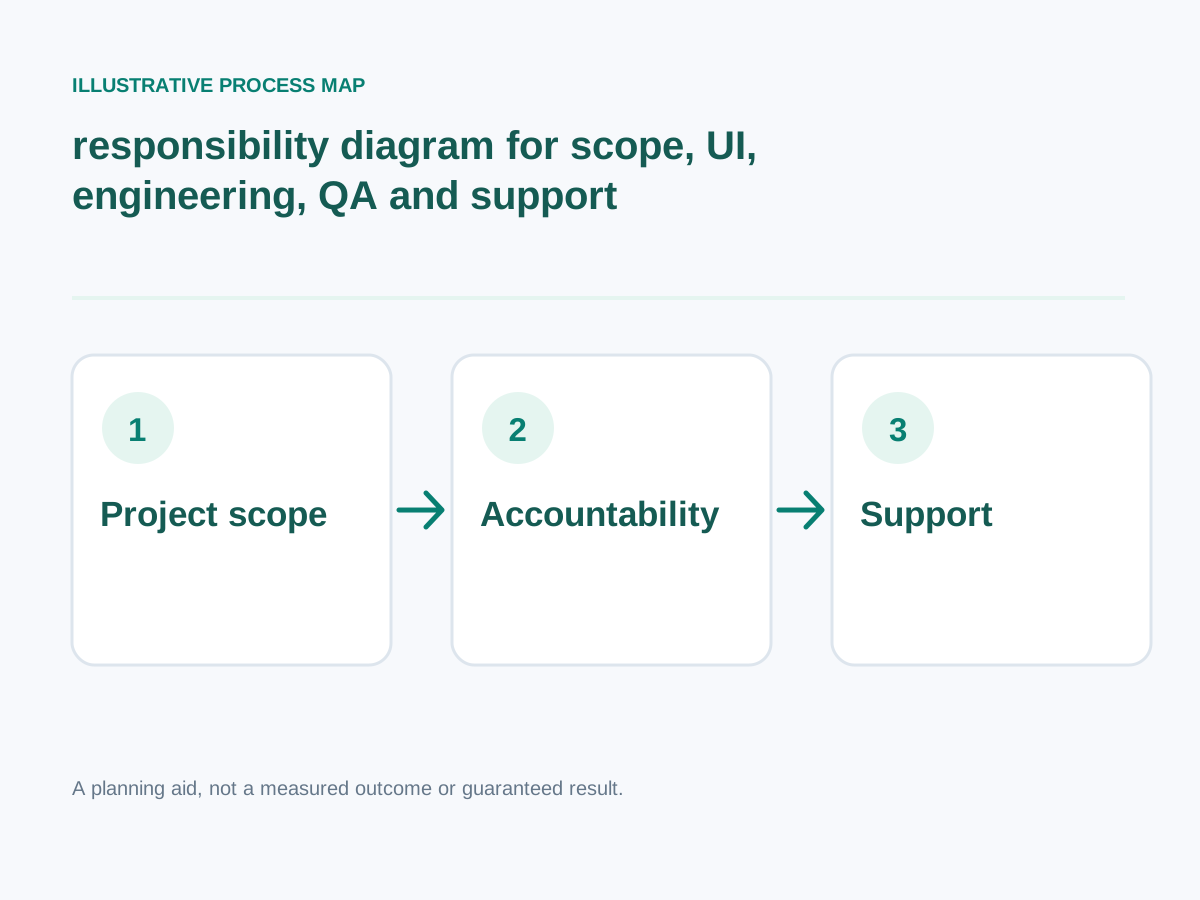
Conceptual illustration; not a client screenshot or measured result.
Protect store data and ownership
Keep merchant ownership of domain, Shopify admin, billing, customer data and permissions. Use collaborator access when appropriate.
How to verify: Run a final credentials and access handover checklist.
Plan post-launch support
Determine who fixes checkout bugs, updates themes and handles app incompatibilities during peak selling periods.
How to verify: Request a documented support and escalation process.
Evaluate migration safety
For established stores confirm product handles, redirects, customer communications, tax, shipping and payment configurations.
How to verify: Run a staging or test-store launch rehearsal.
Clarify app and subscription choices
Some agencies bundle apps that later add monthly cost. Challenge unnecessary dependencies and ensure owner access.
How to verify: Inventory recurring charges and cancellation effects.
Check project communication
Compare direct access to the developer with account-manager coordination and how design feedback reaches engineering.
How to verify: Ask how blockers and revisions are reported.
Assess design and content resources
Decide whether you need brand design, photography, copywriting and CRO research in addition to engineering.
How to verify: List which team member owns each discipline.
Next step: Prioritise the checks relevant to your project, record a baseline, test changes and consult the website development services or book a consultation for implementation support.
Neutral Decision Summary
If you are an early-to-mid-stage business owner needing rapid execution, clean code, and direct collaboration, a specialized Shopify developer offers the ideal balance of agility and value. If your organization demands corporate governance, multiple stakeholder sign-offs, and broad multi-channel marketing campaigns, a structured agency is often the safer fit.